 E-commerce
Starting an Ecommerce Business: Orders, Delivery and Cash Flow
Connect ecommerce orders, stock, delivery, COD payments and customer care. A practical story with AI chat, Social Hub and room to grow into ERP.
Anichur Rahamanvor 1 Tag12min

A practical product-data guide: separate EU deadlines, trace a T-shirt batch, manage corrected supplier evidence and keep restricted information private.
Autor
Anichur Rahaman

A distributor asks a clothing brand which material declaration supports a particular delivery. The brand can find a PDF, but cannot show whether it covers that fabric lot. A neat product page and a printed code do not answer the question. This is a teaching scenario, not a measured customer case.
A DPP is a persistent digital product record linked through an identifier and data carrier, with content and access defined by the applicable rules. The Digital Product Passport, or DPP, makes that distinction important: a route to information is useful only when the information is accurate, applicable and maintained. A QR code is an access mechanism, not evidence that a claim is true.
Start by separating three decisions: which rules apply to your product and role, which records substantiate the required facts, and which people may access them. You can improve those records now without pretending that a voluntary product page is already a compliant passport.
ESPR, Regulation(EU)2024/1781, is a framework for product-specific requirements. A general DPP discussion is not a legal field list for every product. Its scope has exclusions and qualifications; do not reduce it to “all goods except a few” or assume one date for everything sold to Europe.
For each family, record the applicable legislation and adopted product measure, market activity, operator role and effective obligation. Map manufacturer, importer, representative and other actors’ duties for that route. Being outside the EU does not automatically remove an in-scope product obligation; appointing a service provider does not automatically transfer the responsible operator’s duties.
Identify whether the passport is required at model, batch or item level, which carrier and placement are prescribed, and what information/access rights apply. Do not impose serial-level tracking on every product or assume a GS1 implementation is the only permitted route. Use genuine identifiers and the applicable standards. ESPR Articles 9–11 set the framework; product rules provide the specifics.
Keep existing product safety, labelling and other applicable obligations on their own calendar. A future textile DPP date is not permission to postpone today’s fibre-label or safety duties.
The table records selected official checkpoints reviewed on 5 November 2026. An adoption plan, operational infrastructure and a product obligation are different milestones. Check the latest adopted measure and its application date before setting your own deadline.
| Checkpoint / official source | Date or status | What it does not mean |
|---|---|---|
| ESPR framework | In force 18 July 2024 | Not a single DPP deadline for every product |
| DPP Registry | Operational; current site permits organisation enrolment/testing | An index is not a full evidence archive or automatic approval |
| Battery passport, Article 77 | 18 February 2027: electric-vehicle(EV) and light-means-of-transport(LMT) batteries; industrial batteries>2 kWh | The 2 kWh threshold is not a limit on the EV/LMT categories |
| Textile delegated act | Planned adoption Q4 2027; requirements and timing can evolve | Adoption plan is not a binding T-shirt application date |
| Unsold clothing/accessories/footwear | Large companies 19 July 2026; medium 19 July 2030, with scope/exceptions | Destruction rules do not wait for textile DPPs |
Give each field an owner, source, scope and status: requested, received, reviewed, approved or superseded. Record issuer, document version/date, relevant material/model/lot, method and reviewer. Some evidence expires; other evidence needs review after a process or specification change. Do not invent an expiry date for every document.
A supplier declaration and an independent laboratory result are different evidence. “100% cotton”, recycled content, chemical compliance, wash durability and carbon footprint cannot be filled from marketing intuition. Verify the relevant material, trim, test conditions and claim boundary. Unknown is not zero, and “not applicable” needs a reason.
The Commission-hosted September 2026 battery guidance distinguishes fields applicable at passport launch from conditional/later duties. It states carbon-footprint, recycled-content and due-diligence information are not automatically due with every February 2027 passport. Read the underlying provisions for your battery.
For textiles, prepare useful source data while the final sector requirements develop. Do not publish a carbon number or a wash-life rating merely because a sample passport template has that box. Mandatory missing evidence must reach an exception owner; a green completeness score cannot authorise market placement.
Here is an illustrative internal trace, not a statutory textile-passport schema. Model TS-210 has finished batch B-0412. One receipt records 1,000 m of fabric as lot F-88. A production issue sends 600 m to this batch; 400 m remains in that lot, assuming no other movements. The 600 m issue includes any cutting loss recorded for the job; it does not prove 600 m ended up in the shirts.
The job reports 500 finished shirts. Keep material issues, returns, waste and finished output separate, with the actual production evidence. The arithmetic proves the assumed remaining fabric; it does not validate composition, yield or conformity. The table shows a small evidence register you can demonstrate.
If the supplier later corrects declaration v1 to v2, retain both. Record when the correction arrived, its reason and affected scope. Review all linked lots/batches, decide which approved claims change and update the relevant outputs through an authorised process. Do not silently rewrite yesterday’s evidence or propagate an unreviewed correction to every item.
A trace can reveal that the document is wrong, incomplete or unrelated. Keep that result visible and stop unsupported claims. One owning record per fact is useful; it still needs versioning, review and accountable publication.
| Record | Illustrative status/value | Evidence/owner |
|---|---|---|
| Product identity | TS-210 / B-0412,500 finished units | Approved product and production records |
| Material source | F-88,1,000 m received; 600 m issued; 400 m remains | Receipt, issue and reconciliation |
| Supplier statement | Declaration v1 linked to F-88 | Dated source with scope/reviewer |
| Fibre claim | Pending review of garment composition/trim | Product/compliance owner; not guessed |
| Carbon footprint | Unknown; not 0 | Required method/evidence unresolved |
| Correction | v2 retained alongside v1 | Impact review and authorised update history |
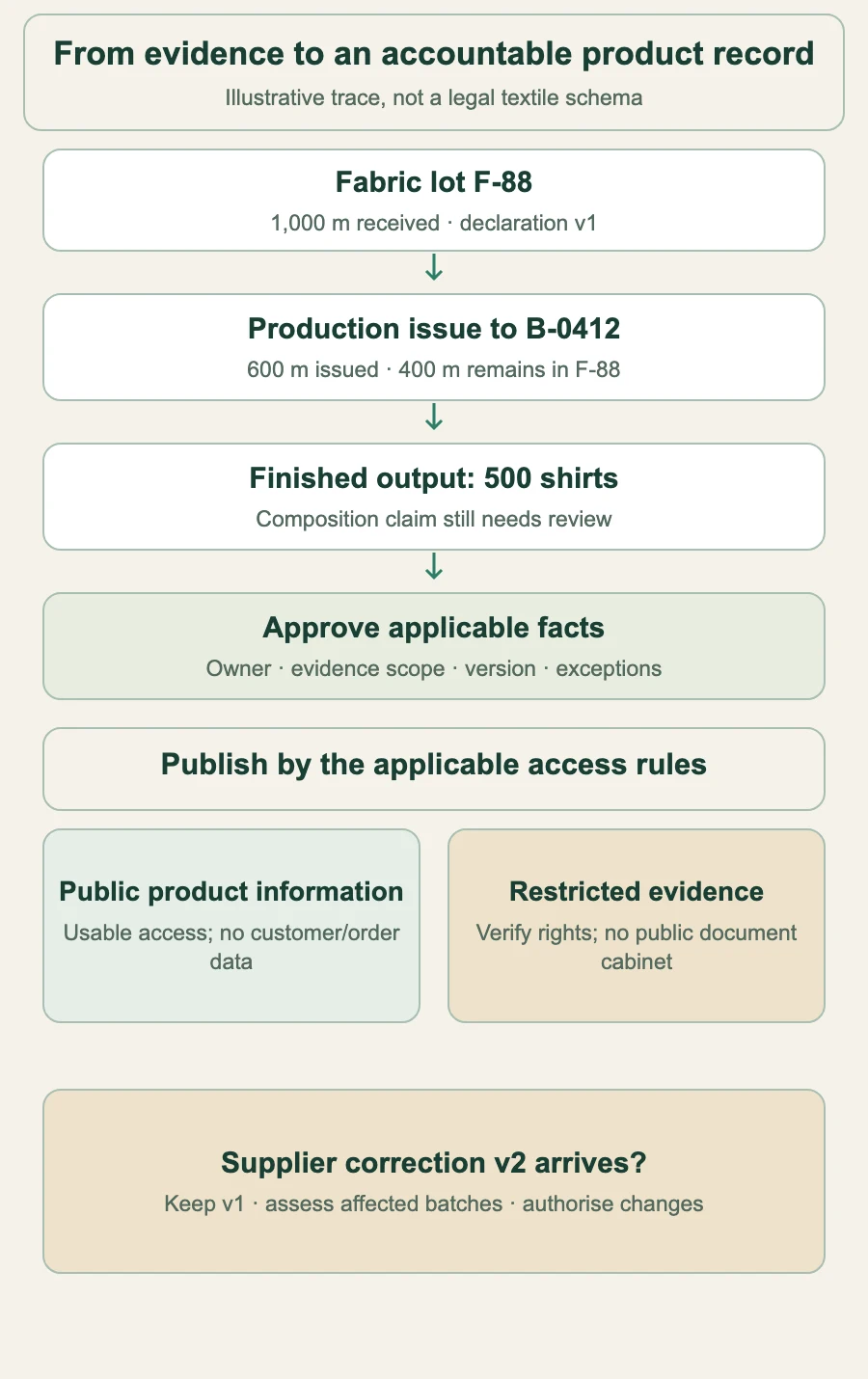
Publish only the information intended for that audience under the applicable rules. Public product facts need a usable route; restricted declarations, reports or commercial detail need verified access. A scanned code, guessable URL or claim to be a recycler is not permission. Keep customer orders, addresses, staff credentials and unrelated supplier contracts out of the public page.
The Commission’s general DPP FAQ distinguishes public access, regulated rights and decentralised data, including availability/backup duties. Configure the actual rules rather than inventing a universal three-tier scheme. Do not put customer personal data into a passport by default.
For a provider, ask about supported identifiers/formats, export, update history, access revocation, availability and the applicable backup arrangement. Test a broken resolver, moved host, expired account and provider exit. A normal ERP backup or a permanent-looking URL alone does not prove the passport’s required long-term availability.
Keep the source document cabinet and public presentation linked by controlled publication, not by making every attachment public. Provide a clear description of missing or changed data rather than a badge implying certification.
The destruction restriction in the checkpoint table is not a textile-passport start date. Check the relevant company-size definition, covered products, national rules and permitted exceptions separately. Regulation 2026/296 sets conditions for derogations; “damaged” or “recycled” is not a blanket permission.
Operationally, record why a lot remains unsold, which reuse/resale route was assessed, who authorised disposition and the evidence for any applicable exception. Do not reduce the legal meaning of destruction to landfill or burning only. A write-down in the accounts neither destroys an item nor authorises its disposal.
Use that record to improve purchasing and returns decisions, without merging destruction reporting, product conformity and DPP duties into one tick box.
Choose one family and name a compliance/scope owner, a product-data owner and the person responsible for supplier exceptions. Confirm the actual obligation dates first, especially if batteries are involved. The work is not a universal twelve-month project or mostly free clerical effort; supplier gaps, testing and provider onboarding can govern the schedule.
Trace a small sample from finished goods to source evidence and back. Have another person reproduce the result. Test missing evidence, wrong lot, a corrected declaration, a public scan and denied restricted access. Use a voluntary demonstration for preparation where appropriate and label it honestly; use the official Registry test environment for supported workflows rather than polluting live records.
Measure approved applicable fields, scope-matched supplier evidence, traceable sampled batches, unresolved exceptions and response time with explicit denominators. Missing mandatory evidence is a stop condition, not something averaged away by a 90% target. A faster answer is useful only when it is supported.
The useful reply to the distributor is therefore not “we have a QR code”. It is a traceable answer with the right version, approved claim and access level—and an honest explanation of anything still unresolved.
Reviewed 5 November 2026. Anichur Rahaman is the creator of StoreConsole. Product, quantities and evidence register are teaching examples; selected checkpoints do not determine every operator’s legal duties.
Über den Autor
Anichur Rahaman
Weiterlesen