 E-commerce
Starting an Ecommerce Business: Orders, Delivery and Cash Flow
Connect ecommerce orders, stock, delivery, COD payments and customer care. A practical story with AI chat, Social Hub and room to grow into ERP.
Anichur Rahamanvor 1 Tag12min

Current official checkpoints for ten markets, plus a practical invoice journey through structured data, validation, delivery, corrections and payment.
Autor
Anichur Rahaman

A wholesaler’s customer asks for structured invoices. The finance manager can send a neat PDF, but the buyer’s system needs fields it can process: tax identifiers, line amounts and a purchase reference. Her first problem is not drawing a better invoice. It is making the existing business data travel correctly.
The wholesaler is a teaching example. Suppose 600 monthly invoices would each need ten minutes of retyping: that is 100 hours of potential work. It is not a measured saving. Structured exchange can remove some re-entry, but data cleanup, review, exceptions and connection support still take time.
This guide checks selected official requirements as of 5 November 2026. It separates legal scope from software capability and a delivery acknowledgement from actual payment. The country checkpoints are a starting map, not an exhaustive list of obligations or exemptions.
A structured e-invoice carries defined machine-readable fields. An ordinary emailed PDF is not enough for mandates requiring structured data. EN 16931 is a European semantic model; UBL and UN/CEFACT CII are syntaxes used to represent it. The destination may require a particular profile, version or local extension, not just any XML.
Hybrid Factur-X/ZUGFeRD files combine a readable PDF with structured XML. Qualification depends on the accepted version/profile and applicable rules; attaching arbitrary XML does not create compliance. Keep the representations consistent and preserve the legally required original components.
Format, exchange network and tax reporting are different layers. Peppol links sender, sender access point, recipient access point and recipient—the four corners. It can coexist with reporting to an authority. Clearance adds authority validation in the issuance path; post-audit arrangements do not require that same pre-clearance. Countries mix models, so these are not three mutually exclusive product choices. See the official Peppol BIS Billing documentation for its actual profiles and validation rules.
For example, Saudi standard tax invoices and simplified invoices have different clearance/reporting treatment; one universal “send to tax authority, then buyer” flow would be misleading. Ask which actual document type, route and reporting obligation apply to your transaction. The distinction is described in ZATCA’s technical guide.
Identify the legal seller and buyer, establishment/VAT status, domestic or cross-border supply, B2B/B2C/B2G category, exemptions and turnover basis. Receiving, issuing, reporting, appointing a provider and penalty relief may have different dates. A customer preference is not by itself a statutory mandate on every supplier.
The table keeps the original article’s ten markets, with current official links rather than an unqualified global deadline. An earlier wave or exception can change the answer for a particular entity. Record who verified your scope and set a review date; do not rely on a screenshot of a timeline forever.
Several dates have already arrived. Being a small business does not automatically remove receiving duties. The summary below omits many sector, transaction and entity exceptions; open the authority link for the applicable detail.
| Market / official source | Checkpoint and important scope |
|---|---|
| Germany | Domestic B2B receiving since 1 Jan 2025. Issuing generally from 1 Jan 2027 for prior-year turnover>€800,000, otherwise 1 Jan 2028, subject to exemptions/EDI transition. Small-business issuance exemption does not waive receiving. |
| Belgium | In-scope domestic B2B structured exchange since 1 Jan 2026. Peppol is the default route; an agreed compliant alternative and statutory exceptions need separate checking. Not merely “Peppol recommended”. |
| Croatia | Domestic B2B: VAT-system taxpayers issue/receive with fiscalisation from 1 Jan 2026. Relevant non-VAT taxpayers receive in 2026 and begin issuing from 1 Jan 2027. |
| Poland | KSeF receiving from 1 Feb 2026; issuance 1 Feb for 2024 VAT-inclusive sales abovePLN 200m,1 Apr for others. Monthly invoiced gross sales≤PLN 10,000 can defer issuance through 2026 under transitional conditions. |
| France | In-scope receiving from 1 Sep 2026; large/ETI entities issue then, SME/micro entities from 1 Sep 2027. ETI is not the SME category. Approved-platform and separate e-reporting scope matter. |
| Spain | Order HAC/1028/2026 effective 6 Oct 2026 starts the clock: in-scope prior-year turnover>€8m from 6 Oct 2027; others 6 Oct 2028. Payment-status reporting has further phased rules. The order is no longer pending. |
| UAE | In-scope revenue≥AED 50m: ASP appointment 30 Oct 2026; implementation 1 Jan 2027. Lower-revenue cohort: appointment 31 Mar 2027,implementation 1 Jul 2027; government implementation 1 Oct 2027. Check current scope/exclusions and the separate pilot. |
| Saudi Arabia | ZATCA Wave 25: VAT-subject revenue>SAR 187,500 in any of 2022–2025; notified integration by 1 Feb 2027. Earlier-wave duties still apply. Follow your notice and document-type clearance/reporting rules. |
| Malaysia | Current HASiL exemption is annual turnover/revenue<RM 3m, with related-entity/shareholder exceptions. Phase 4 generally 1 Jan 2026; new-business dates differ. Eligibility and conditional relaxation to 31 Dec 2027 need current Guidelines 4.8/Specific 4.9; the old RM 1m headline is outdated. |
| European Union | ViDA cross-border B2B digital reporting based on mandatory e-invoicing from 1 Jul 2030. Earlier domestic mandates remain; this is not one universal 2026/2028 start date. |
Spain’s separate billing-software/SIF rules, including VERI*FACTU options, must not be confused with the B2B e-invoice exchange dates. The consolidated RD 1007/2023 schedule sets 1 January 2027 for the specified corporate-tax cohort and 1 July 2027 for other in-scope taxpayers.
For Malaysia, check the actual Guideline 4.8, sections 1.5–1.6 and Specific Guideline 4.9, section 16. Relaxation is conditional, not an exemption from every requirement. UAE’s amended Decision 66/2026 confirms the AED 50m-and-above boundary and appointment date.
Use a controlled invoice record containing the legal parties, tax determination, units, quantity, prices, allowances, currency, dates, terms and routing/buyer references. Generate the structured file and readable view from it, then validate both. Shared source data reduces disagreement; it does not make rounding or formatting bugs impossible.
For arithmetic only, consider three units at 30: subtotal 90, a 10% line discount 9, taxable net 81. At an assumed 20% tax, tax 16.20 and total 97.20. This invented rate is not tax advice for any market. Check the required line/header rounding, allowance and tax-category rules, not just whether the XML parses.
A missing buyer reference, invalid identifier or wrong tax treatment may need different correction. Some references are profile/customer requirements rather than universal fields. Tax depends on the actual transaction and parties, not merely a fixed rate attached to a product. Validate tax IDs where authoritative checks exist, and control changes to routing or bank information.
Outbound conversion or inbound extraction is not automatically wrong, but it needs verified mapping and controls. If the original approved data is available, turning it into PDF and then recovering it by OCR adds an avoidable reconstruction step.
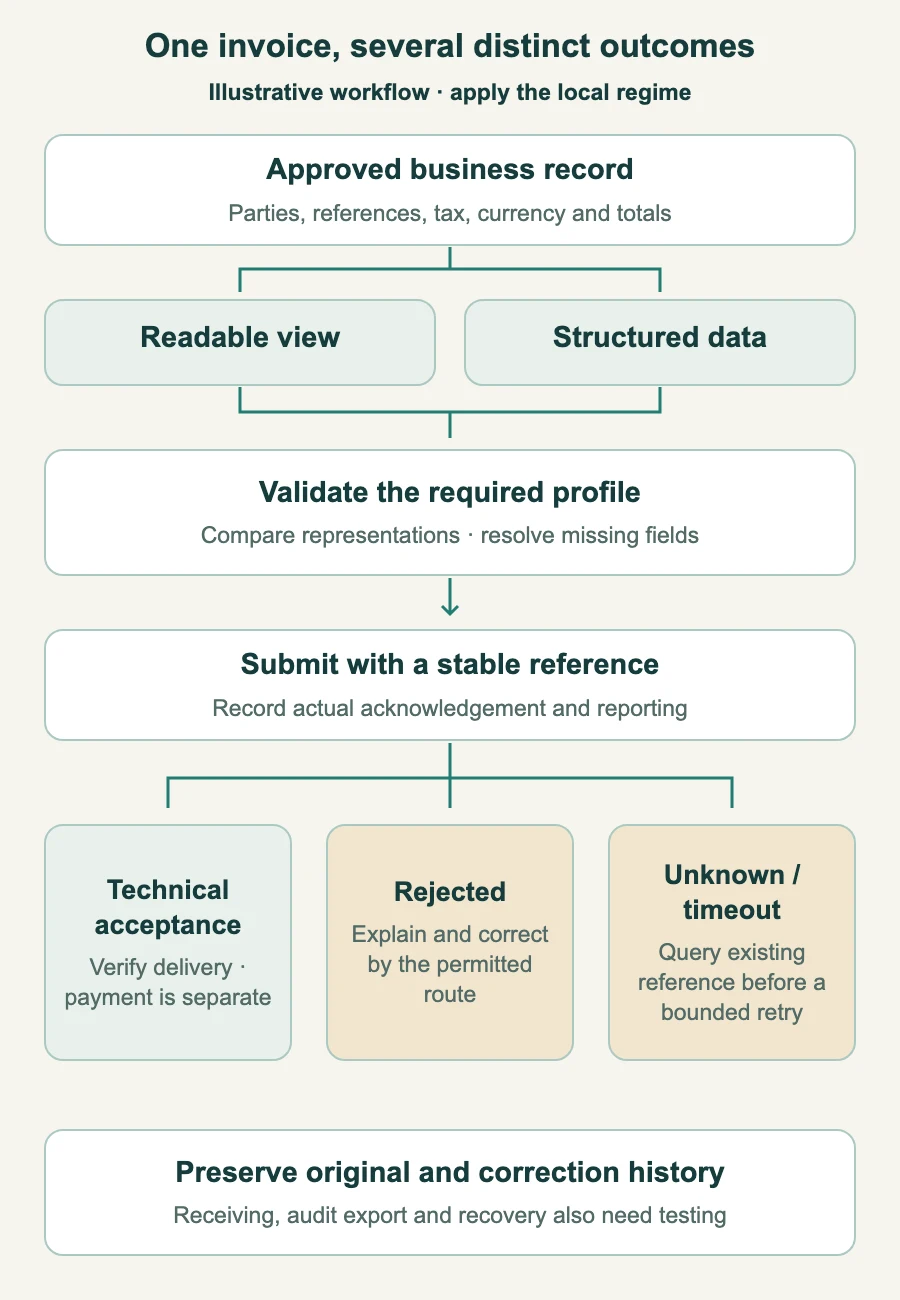
Keep an immutable business reference plus provider/authority identifiers and status history. Local validation, submission, technical acceptance, delivery, buyer response and payment are different facts. Authority acceptance does not prove the invoice is commercially correct, approved for payment or paid.
When a connection times out, query the existing reference before resubmitting. Use duplicate protection, bounded backoff for retryable outages and a named exception owner. Do not silently create a fresh invoice number for an unknown outcome. Fix invalid data or credentials instead of repeatedly sending the same rejection.
An invoice already issued or accepted may require cancellation within an allowed window, a correction document, credit/debit note or replacement with prescribed references. The exact route depends on the regime and error; not every change is “credit note plus new invoice”. Preserve original evidence and apply authorised corrections rather than deleting history.
Agree lawful outage/offline procedures and reporting deadlines for each regime. A generic fallback PDF or delayed retry is not automatically permitted. Track separate reporting obligations even when the buyer has received the document.
Confirm that incoming files reach the right legal entity and accounts-payable queue, can be rendered, validated and matched to supplier/order/receipt, and have an owner for exceptions. Receiving an e-invoice does not automatically approve its tax, payment or a supplier-bank change.
Treat attachments as untrusted input. Use controlled parsing, malware protections and restricted storage; an invoice is not a public marketing image. Restrict staff and AI access by role/entity, and retain original files, required components, acknowledgements and corrections for the applicable period.
Test readable audit export and restore, including a provider exit. A provider portal or backup alone is not proof you meet retention, integrity and accessibility duties. No single worldwide retention period applies.
Give finance ownership of scope/tax, sales or master-data owners responsibility for customer details, and an operational owner the connection, credentials, renewal and outages. Compare onboarding, per-document charges, support, data export, service levels and exit terms. A software vendor’s “e-invoicing ready” badge is not proof of an accredited connection in every country.
In a permitted test environment, run ordinary sales, discounts, partial credits, cancellation/correction, foreign parties, missing buyer references, duplicate sends, expired credentials, timeouts and incoming invoices. Check actual acknowledgements, legal references, reporting and archive retrieval—not only a successful PDF preview.
Start with a controlled customer group where legally allowed, then expand after reconciliation and training. Project duration depends on scope, data quality and provider onboarding; a quarter is not a universal promise. Maintain a manual authorised exception process and sufficient capacity before mandatory dates.
Measure verified re-entry time, review/support effort, rejection reasons, unresolved age and time to a valid delivered invoice. Separate those gains from late-payment behaviour and cash savings. The wholesaler’s 100-hour retyping scenario is a baseline assumption; it does not prove 100 hours disappear or customers pay faster.
The finance manager can now ask a useful question: can we demonstrate one invoice that matches our approved data, reaches this buyer by the right route, has the correct status and can later be corrected and retrieved? Then she asks the same for an incoming invoice.
That is a stronger purchase criterion than “exports XML”. It also leaves the business with clear owners when the next rule, customer reference or connection changes.
Reviewed 5 November 2026. Anichur Rahaman is the creator of StoreConsole. The wholesaler, workload and tax arithmetic are teaching examples; selected country checkpoints are not a complete determination of an entity’s obligations.
Über den Autor
Anichur Rahaman
Weiterlesen