A Smaller Cloud Bill—or a Bigger Operations Job? Price the Whole Move
Compare the service you need, not a cloud invoice against a bare server. Include people, recovery and exit costs before choosing managed hosting, repatriation or a hybrid.
Penulis
Anichur Rahaman
1 bulan yang lalu6 menit baca162 tampilan
The owner sees a rising cloud invoice; the engineer finds a much cheaper server rental. Both numbers can be correct while the proposed saving is wrong. Someone still has to patch the database, restore a lost record, answer the night call and make the next hardware failure survivable.
This teaching comparison asks what the business must keep working, who will operate it and what the full move costs. Repatriation can mean selected workloads leaving a large public-cloud provider, not necessarily buying a rack or moving everything. Regional cloud, managed hosting and hybrid arrangements belong in the comparison too.
Compare an operating service with an operating service
Start with required availability, tested peak/failure capacity, data-loss tolerance, recovery time, support, location and security duties. Two machines in one failure domain are not automatically equivalent to a tested multi-zone service. Include replacement lead time, spare capacity and an escalation path; do not erase resilience to make a rental look cheaper.
AWS’s shared responsibility model illustrates how duties change by service. Managed does not mean the customer has no security or data responsibility; self-managed does not automatically mean operating your own building. Write the patching, credentials, database recovery, backup, monitoring and on-call owner for each option.
Predictable demand can make fixed capacity attractive, but neither steady load nor a monthly bill above a magic threshold guarantees savings. Bursts, GPU needs, storage growth and supplier capacity affect both models. A hybrid that separates application and database across providers may add network latency, transfer fees and another failure boundary. Test that whole path, not only the cheaper node.
Build a fair monthly budget, then price the people
The table is a hypothetical budget in one currency unit, not provider quotes or a StoreConsole price. It assumes each candidate must first pass the same functional, recovery and performance acceptance; the table itself proves no topology or SLA. Count support/labour once and compare the same tax/discount basis. Common application licence costs are omitted only if identical; include any differences.
Monthly allocation
Managed services
Self-managed host
App/worker runtime
400
250
Database capacity and recovery
700
300
Cache/queue services
150
100
Storage, backup and network
200
200
Monitoring/security tools
100
150
Infrastructure subtotal
1,550
1,000
Operations: 20 h /40 h at 40
800
1,600
Total monthly cost
2,350
2,600
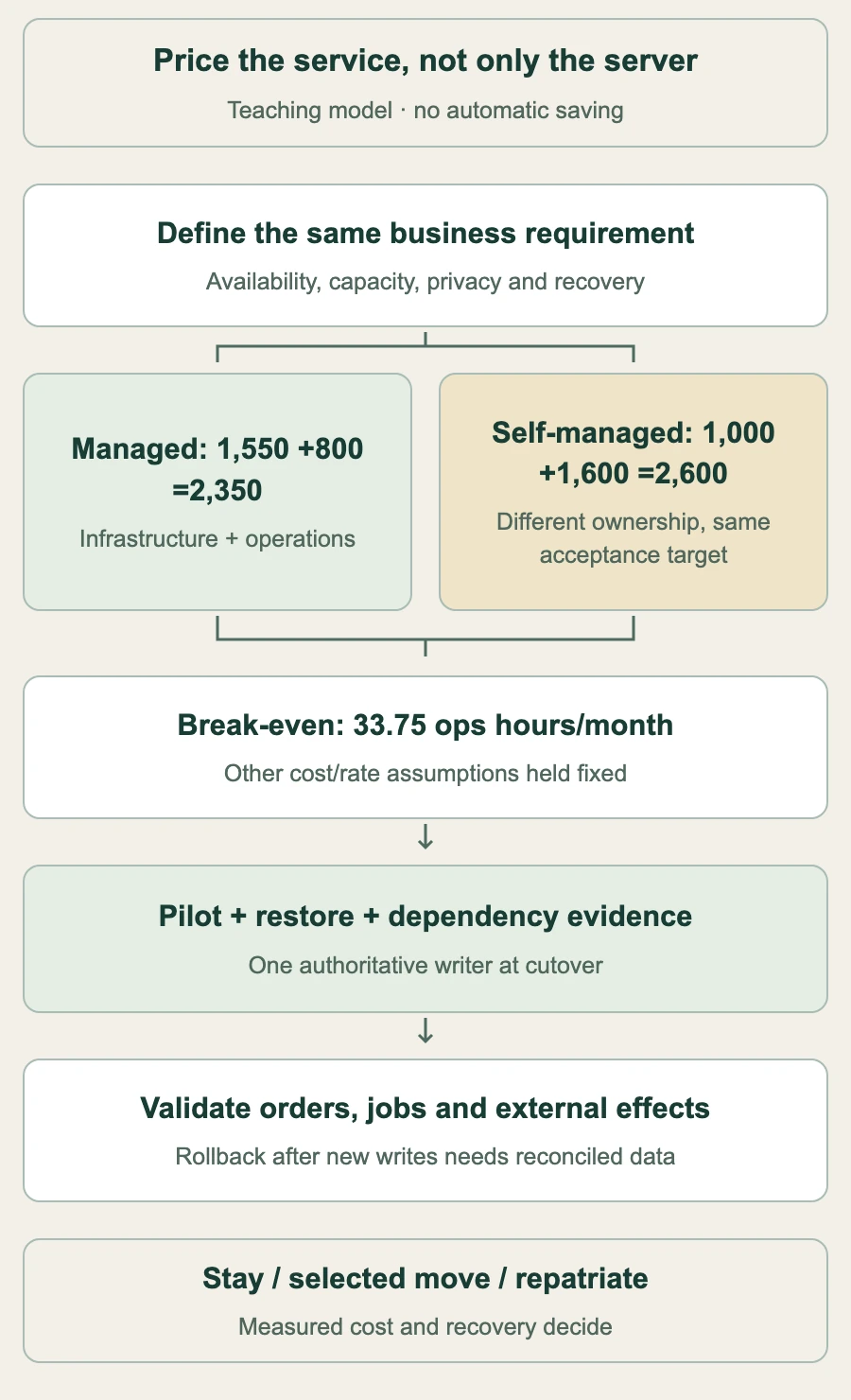
Managed infrastructure allocations sum to 1,550 and self-managed to 1,000: apparent infrastructure saving 550. At 40 per operations hour, 20 hours add 800 to the managed option and 40 hours add 1,600 to self-managed. Totals are 2,350 versus 2,600. The cheaper infrastructure costs 250 more monthly after operations.
Holding those other assumptions fixed, self-managed break-even operations time is(2,350−1,000)÷40=33.75 hours/month. That is not an industry staffing rule or a recommendation to work unpaid. Budget cover for absence, incidents and skills; an already employed engineer’s time still has an opportunity cost.
In a separate sensitivity case, 25 self-managed hours cost 1,000, making total 2,000 and saving 350 monthly. A one-off migration 6,000 would take about 17.1 months to recover at that constant saving, before overlap, financing, tax or risk. In the original 40-hour case there is no positive saving to pay it back; year-one incremental cost is 12×250+6,000=9,000 before overlap. Label the scenario rather than mixing favourable assumptions.
Fix waste and read the actual transfer contract
Attribute the bill to workloads: idle capacity, snapshots, logs, replica traffic, storage operations, NAT, inter-zone/region transfer and internet delivery. Compare right-sizing, lifecycle cleanup and appropriate commitments before migrating. A commitment can lower a unit rate while leaving an exit liability. A CDN changes origin traffic but is not an automatic reduction in total cost.
Use the provider’s current service/region and account terms. For example, AWS’s EC 2 pricing reference separates transfer categories and eligibility; one advertised per-GB rate is not every service’s rate. A rental allowance also has caps, fair-use rules and overage. There is no universal free ingress, included 20 TB or fixed egress saving.
AWS’s exit-transfer programme has eligibility, notice and process requirements; it is not free everyday internet delivery. Obtain the actual terms before budgeting a waiver. For in-scope EU Data Act switching, switching charges, including relevant switching egress, end 12 January 2027. Check scope/exceptions; do not apply that date to every ordinary traffic bill or assume an EU customer makes every contract eligible.
Data residency also needs a full map: primary, replicas, backups, logs, support access and subprocessors. Location alone does not establish security, lawful access or compliance. Confirm the applicable obligations and contract with the responsible owner. Containers can help portability, but managed queues, identity, secrets, networking and data formats may still need substantial work. No “one afternoon” migration promise.
Transfer write authority, not just DNS
Inventory dependencies and choose a version-compatible transfer method. Build the target, restore a backup and verify recovery evidence against the agreed RPO/RTO; PostgreSQL continuous-archiving documentation is one relevant reference. Check roles, extensions, encoding, jobs, files and secrets as well as rows. Counts/checksums alone do not prove a functioning business system.
PostgreSQL logical-replication restrictions include schema/DDL and sequence state: copied rows do not automatically prepare a subscriber to become the new writer. Check the specific versions, replica identity and non-table objects. A physical standby and a logical subscriber are different designs; reverse replication is not an automatic rollback feature.
Before cutover, fence every old writer—web, workers, schedulers, imports and callbacks—using a rehearsed plan. Catch up and reconcile accepted operations, switch the authoritative write route, validate and resume deliberately. Coordinate queues, idempotency records and external payment/shipping effects; do not let two copies independently fulfil the same obligation.
Lowering DNS TTL can influence cache refresh, but does not close existing connections or instantly move every client. A stale client must not keep writing to the old database. Define rollback before and after the first new write; afterwards, returning to an old copy can lose new orders. A tested data-reconciliation/reversal route is required, or the chosen response may be forward recovery.
Teaching decision flow. Stay, move selected work or repatriate only after comparable service and recoverability are demonstrated.
Make the decision reversible in cost as well as design
A pilot should produce acceptance evidence and a measured support workload. Keep overlap only as long as the recovery/contract requirements justify it; a fixed 30 days or 13 weeks is not universally safe. Keep protected backups and required records. Retire resources only after verifying the real dependencies and stop dates, including billing commitments.
Decision gate
Evidence to retain
Comparable service
Peak/failure capacity, RPO/RTO and access controls
Whole cost
Labour, support, overlap, commitments and exit terms
Transfer readiness
Successful restore; compatible schema/state; one writer
After cutover
Reconciled orders/jobs/payments; measured support load
Review total cost per useful business unit, operations hours, outstanding critical patches, incident load, recovery drills and latency from the customer regions. Patch age means time a required fix remains unremediated, not time since the last patch was installed. If support, correctness or recovery fails acceptance, rework the plan even when rent is low.
The owner’s useful outcome is a bill and an operating model they can explain. That can mean staying, moving one workload, buying managed support or repatriating more. The right choice pays for the service the business actually needs, including the people who keep it working.
Reviewed 6 November 2026. Anichur Rahaman, creator of StoreConsole. Budget and payback figures are illustrative, not quotes, observed savings or financial forecasts.



 Infrastructure & Scaling

