E-Invoicing у 2026 році: визначтеScope, а потім дотримуйтеся вимог до рахунку
Актуальні офіційні контрольні точки для десяти ринків, а також практичний шлях роботи з рахунком через структуровані дані, перевірку, доставку, виправлення та оплату.
Автор
Anichur Rahaman
3 місяці тому10 хв читання184 переглядів
Покупець оптового постачальника просить надсилати структуровані рахунки. Фінансовий менеджер може надіслати оформлений PDF, але системі покупця потрібні поля, які вона зможе обробити: податкові ідентифікатори, суми позицій і посилання на закупівлю. Її перша проблема — не створити красивіший рахунок, а забезпечити правильну передачу наявних бізнес-даних.
Оптовий постачальник — це навчальний приклад. Уявімо, що на кожен із 600 щомісячних рахунків потрібно витрачати по десять хвилин на повторне введення: це 100 годин потенційної роботи. Це не підтверджена економія. Структурований обмін може усунути певну частину повторного введення, але очищення даних, перевірка, винятки та підтримка підключення все ще потребують часу.
Цей посібник перевіряє окремі офіційні вимоги станом на 5 листопада 2026 року. Він розмежовує юридичний Scope і можливості програмного забезпечення, а також підтвердження доставки й фактичну оплату. Країнові контрольні точки — це початкова карта, а не вичерпний перелік обов’язків або звільнень.
Зрозумійте документ, перш ніж обирати підключення
Структурований електронний рахунок містить визначені машиночитні поля. Звичайного PDF, надісланого електронною поштою, недостатньо для вимог, що передбачають структуровані дані. EN 16931 — європейська семантична модель; UBL і UN/CEFACT CII — синтаксиси, які використовують для її представлення. Отримувач може вимагати певний профіль, версію або локальне розширення, а не будь-який XML.
Гібридні файли Factur-X/ZUGFeRD поєднують читабельний PDF зі структурованим XML. Відповідність залежить від прийнятої версії/профілю та чинних правил; додавання довільного XML не забезпечує відповідність вимогам. Підтримуйте узгодженість представлень і зберігайте оригінальні компоненти, обов’язкові за законом.
Формат, обмінна мережа та податкова звітність — це різні рівні. Peppol пов’язує відправника, точку доступу відправника, точку доступу одержувача та одержувача — чотири кути. Його можна використовувати разом зі звітністю перед органом влади. Clearance додає перевірку органом влади до шляху виставлення; post-audit arrangements не потребують такого самого попереднього clearance. Країни поєднують різні моделі, тому це не три взаємовиключні варіанти продукту. Перегляньте офіційну документацію Peppol BIS Billing щоб дізнатися про чинні профілі та правила перевірки.
Наприклад, стандартні податкові рахунки та спрощені рахунки в Саудівській Аравії мають різний порядок clearance/звітності; єдиний универсальний процес «надіслати податковому органу, потім покупцеві» був би вводом в оману. З’ясуйте, який тип документа, маршрут і звітний обов’язок застосовуються до вашої операції. Цю відмінність описано в технічному посібнику ZATCA.
Перетворіть загальний строк на власний обов’язок
Визначте юридичного продавця та покупця, статус підприємства й VAT, внутрішньодержавну або транскордонну поставку, категорію B2B/B2C/B2G, звільнення та основу для розрахунку обороту. Дати отримання, виставлення, звітності, призначення провайдера та звільнення від штрафів можуть відрізнятися. Побажання клієнта саме по собі не є обов’язковим вимогою закону для кожного постачальника.
У таблиці збережено десять ринків з оригінальної статті та наведено актуальні офіційні посилання замість безумовного глобального строку. Попередня хвиля або виняток може змінити відповідь для конкретної організації. Зафіксуйте, хто перевірив ваш Scope, і встановіть дату повторного огляду; не спирайтеся на скриншот графіка вічно.
Обрані контрольні точки, переглянуто 5 листопада 2026 року
Кілька дат уже настали. Статус малого бізнесу не звільняє автоматично від обов’язків щодо отримання. Узагальнення нижче не охоплює багатьох галузевих, операційних і організаційних винятків; відкрийте посилання на орган влади, щоб переглянути застосовні деталі.
Внутрішньодержавне B2B-отримання з 1 січня 2025 року. Загалом виставлення з 1 січня 2027 року за оборотом попереднього року >€800 000, інакше — з 1 січня 2028 року, з урахуванням звільнень/EDI-перехідного періоду. Звільнення малого бізнесу від виставлення не скасовує обов’язок щодо отримання.
Структурований обмін у межах Scope для внутрішньодержавних B2B-операцій із 1 січня 2026 року. Peppol є маршрутом за замовчуванням; узгоджена відповідна альтернатива та законодавчі винятки потребують окремої перевірки. Це не просто «рекомендовано використовувати Peppol».
Внутрішньодержавні B2B: платники VAT виставляють/отримують рахунки з fiscalisation з 1 січня 2026 року. Відповідні платники, що не є платниками VAT, отримують рахунки у 2026 році та починають виставляти їх з 1 січня 2027 року.
Отримання через KSeF з 1 лютого 2026 року; виставлення — 1 лютого для продажів 2024 року з VAT понад PLN 200 млн, 1 квітня для інших. Щомісячний виставлений валовий продаж ≤PLN 10 000 може відкласти виставлення до кінця 2026 року за перехідних умов.
Отримання в межах Scope із 1 вересня 2026 року; великі підприємства та ETI виставляють рахунки з цієї дати, SME/мікропідприємства — з 1 вересня 2027 року. ETI — це не категорія SME. Мають значення схвалена платформа та окремий Scope для e-reporting.
Наказ HAC/1028/2026, що набуде чинності 6 жовтня 2026 року, запускає відлік: підприємства в межах Scope з оборотом попереднього року >€8 млн — з 6 жовтня 2027 року; інші — 6 жовтня 2028 року. Для звітності про статус оплати діють додаткові етапні правила. Наказ більше не перебуває на розгляді.
Дохід у межах Scope ≥AED 50 млн: призначення ASP — 30 жовтня 2026 року; впровадження — 1 січня 2027 року. Для групи з меншим доходом: призначення — 31 березня 2027 року, впровадження — 1 липня 2027 року; державне впровадження — 1 жовтня 2027 року. Перевірте актуальний Scope/винятки та окремий pilot.
Хвиля 25 ZATCA: дохід, що підлягає оподаткуванню VAT, >SAR 187 500 у будь-якому з 2022–2025 років; інтеграція після сповіщення — до 1 лютого 2027 року. Обов’язки попередніх хвиль застосовуються і далі. Дотримуйтеся свого повідомлення та правил clearance/звітності для відповідного типу документа.
The current HASiL exemption is for annual turnover/revenue <RM 3m, with exceptions for related entities and shareholders. Phase 4 generally starts on 1 Jan 2026; dates for new businesses differ. Eligibility and conditional relaxation until 31 Dec 2027 must be checked against the current Guidelines 4.8/Specific 4.9; the old RM 1m threshold is outdated.
ViDA cross-border B2B digital reporting is based on mandatory e-invoicing from 1 Jul 2030. Earlier domestic mandates remain; this is not a single universal 2026/2028 start date.
Spain’s separate billing-software/SIF rules, including VERI*FACTU options, must not be confused with the B2B e-invoice exchange dates. The consolidated RD 1007/2023 schedule sets 1 January 2027 for the specified corporate-tax cohort and 1 July 2027 for other in-scope taxpayers.
Build both representations from a single approved record
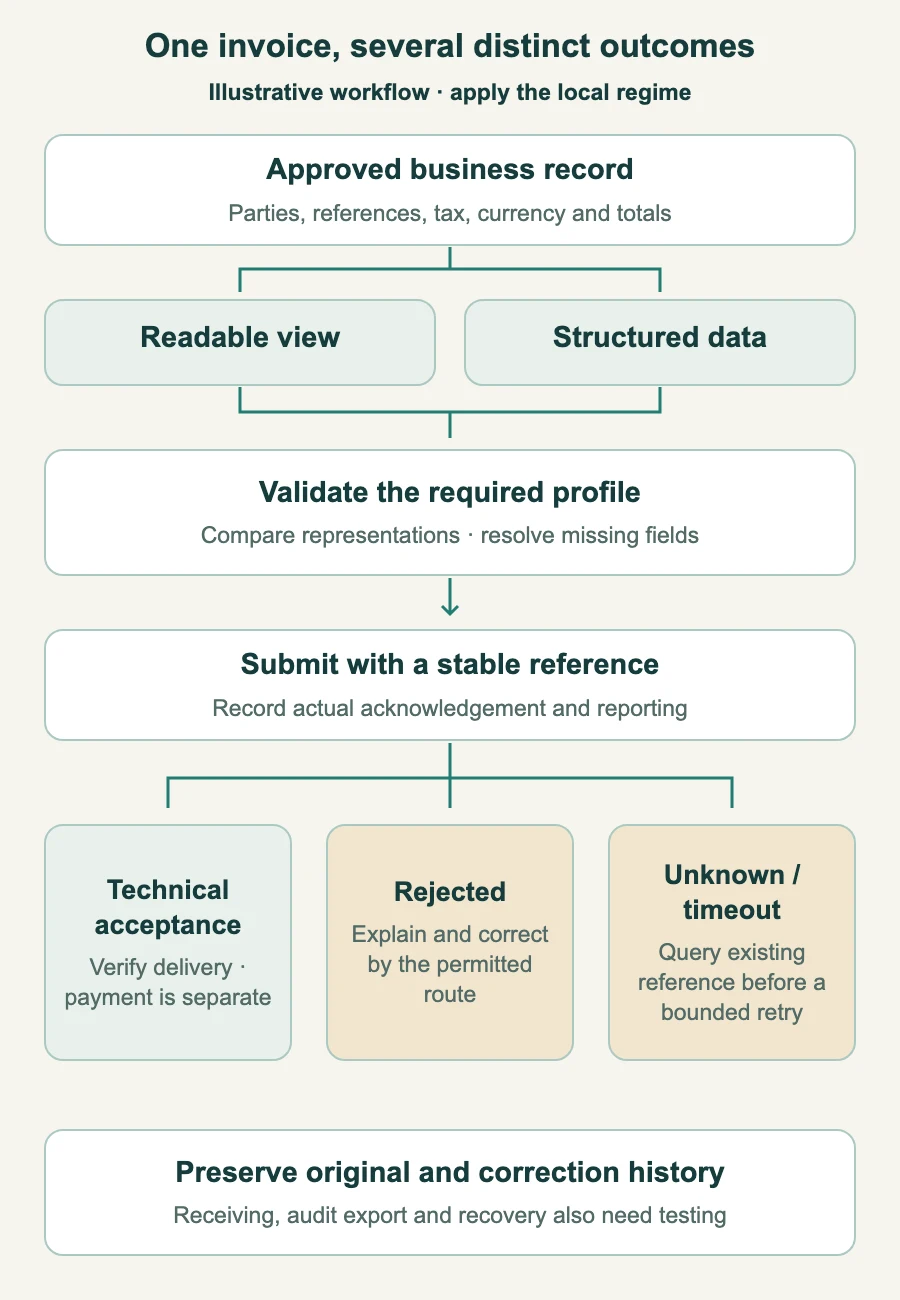
Use a controlled invoice record containing the legal parties, tax determination, units, quantity, prices, allowances, currency, dates, terms and routing/buyer references. Generate the structured file and readable view from it, then validate both. Shared source data reduces discrepancies; it does not eliminate rounding or formatting errors.
For arithmetic purposes only, consider three units at 30: subtotal 90, a 10% line discount of 9 and taxable net of 81. At an assumed tax rate of 20%, tax is 16.20 and the total is 97.20. This invented rate is not tax advice for any market. Check the required line/header rounding, allowance and tax-category rules, not just whether the XML parses.
A missing buyer reference, invalid identifier or incorrect tax treatment may require a different correction. Some references are profile/customer requirements rather than universal fields. Tax depends on the actual transaction and parties, not merely on a fixed rate attached to a product. Validate tax IDs wherever authoritative checks are available, and control changes to routing or bank information.
Outbound conversion or inbound extraction is not automatically wrong, but it requires verified mapping and controls. If the original approved data is available, converting it to PDF and then recovering it through OCR introduces an unnecessary reconstruction step.
This is a general control flow, not a claim that every country uses clearance or the same correction procedure. Acceptance is not payment.
Track delivery, legal acceptance and payment separately
Keep an immutable business reference alongside provider/authority identifiers and a status history. Local validation, submission, technical acceptance, delivery, buyer response and payment are separate facts. Authority acceptance does not prove that an invoice is commercially correct, approved for payment or has been paid.
When a connection times out, query the existing reference before resubmitting. Use duplicate protection, bounded backoff for retryable outages and a named owner for exceptions. Do not silently create a new invoice number for an unknown outcome. Correct invalid data or credentials instead of repeatedly sending the same rejected invoice.
An invoice already issued or accepted may require cancellation within an permitted period, a correction document, a credit/debit note or a replacement with prescribed references. The exact route depends on the regime and error; not every change is a “credit note plus new invoice”. Preserve the original evidence and apply authorised corrections rather than deleting the history.
Agree lawful outage/offline procedures and reporting deadlines for each regime. A generic PDF fallback or delayed retry is not automatically permitted. Track separate reporting obligations even when the buyer has received the document.
Receiving and archiving are part of the project
Confirm that incoming files reach the correct legal entity and accounts-payable queue, can be rendered, validated and matched to the supplier/order/receipt, and have an owner for exceptions. Receiving an e-invoice does not automatically approve its tax treatment, payment or a supplier bank-detail change.
Treat attachments as untrusted input. Use controlled parsing, malware protection and restricted storage; an invoice is not a public marketing image. Restrict staff and AI access by role/entity, and retain original files, required components, acknowledgements and corrections for the applicable period.
Test readable audit exports and restoration, including provider exit. A provider portal or backup alone does not prove that you meet retention, integrity and accessibility obligations. No single worldwide retention period applies.
Test the complete journey, then measure useful work
Give finance ownership of scope/tax, give sales or master-data owners responsibility for customer details, and assign an operational owner responsibility for connections, credentials, renewals and outages. Compare onboarding, per-document charges, support, data export, service levels and exit terms. A software vendor’s “e-invoicing ready” badge is not proof of an accredited connection in every country.
In a permitted test environment, run standard sales, discounts, partial credits, cancellations/corrections, foreign-party transactions, missing buyer references, duplicate submissions, expired credentials, timeouts and incoming invoices. Check the actual acknowledgements, legal references, reporting and archive retrieval—not just a successful PDF preview.
Start with a controlled customer group where legally permitted, then expand after reconciliation and training. Project duration depends on scope, data quality and provider onboarding; one quarter is not a universal commitment. Maintain a manual, authorised exception process and sufficient capacity before mandatory dates.
Measure verified re-entry time, review/support effort, rejection reasons, unresolved-item age and time to a valid delivered invoice. Separate these gains from late-payment behaviour and cash savings. The wholesaler’s 100-hour re-entry scenario is a baseline assumption; it does not prove that 100 hours disappear or that customers pay faster.
Back to the buyer’s request
The finance manager can now ask a useful question: can we demonstrate one invoice that matches our approved data, reaches this buyer through the correct route, has the correct status and can later be corrected and retrieved? Then she asks the same question about an incoming invoice.
That is a stronger purchasing criterion than “exports XML”. It also leaves the business with clear ownership when the next rule, customer reference or connection changes.
Reviewed 5 November 2026. Anichur Rahaman is the creator of StoreConsole. The wholesaler, workload and tax arithmetic are teaching examples; selected country checkpoints do not constitute a complete determination of an entity’s obligations.



 E-commerce