Manufacturing ERP for Small Producers: Plan a Batch, Record What Happened
Follow one workshop batch through BOM versions, yield, actual consumption, costing and lot traceability, with quantities and packaging reconciled.
Penulis
Anichur Rahaman
1 bulan yang lalu8 menit baca170 tampilan
The workshop’s sheet says 14 kg of shea butter. The owner finds 10. Four kilograms went into an earlier run without a recorded issue. She has promised 100 jars for Friday, and a supplier has just asked which products used a particular lot. The scene is fictional, but the questions are familiar: what can we make, what did we use, and where did it go?
A small manufacturer needs more than a recipe file. The plan, physical movements, quality decisions and cost must agree. Software can connect those records; people still need to capture them accurately and investigate differences. A work order does not make a missing movement true by itself.
Follow the batch below. It is a planning and accounting example with invented prices, not a validated cosmetic formulation or a safety specification. The aim is a clear chain of evidence from approved materials to released finished goods.
Give the BOM a version and a clear basis
A bill of materials states components, quantities and units for a defined output. Separate the balm base from jars, labels and cartons. The base can have its own BOM and be stocked or made separately. If a batch consumes already-made base, do not also consume its raw ingredients a second time.
Record the approved version, effective date, output basis, units/conversions and loss convention. Freeze that version or an immutable snapshot for the released work order. Later edits should apply through controlled changes, not rewrite history. Substitutions and rework need their own approval and record.
BOM-version controls are a common manufacturing concept; Microsoft’s BOM documentation provides one implementation example. Confirm the actual approval and consumption behaviour in the system you use.
Work backward from good output
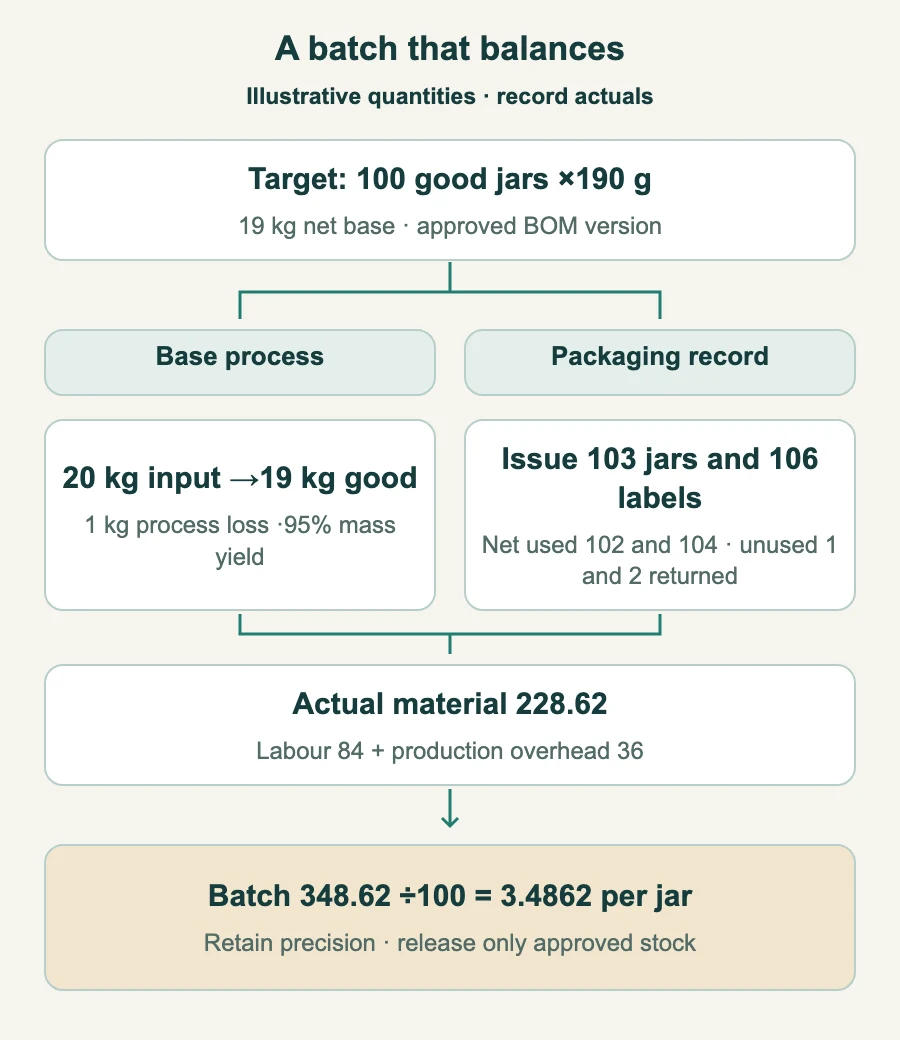
Suppose the agreed output is 100 good jars at 190 g each: net base 19 kg. Assume a normal process yield of 95%, meaning 5% of input is lost. Required input = 19/0.95 = 20 kg , of which 1 kg is process loss. Adding 5% to 19 would give 19.95, which at 95% yield produces only 18.9525 kg. State the denominator instead of treating those conventions as interchangeable.
For arithmetic only, split the 20 kg input 55%/35%/10%: shea 11 kg at 8/kg, oil 7 kg at 5/kg, wax 2 kg at 14/kg. Base material cost is 88+35+28 = 151. The packaging plan allows 103 jars/lids, 106 labels and 9 cartons, with each carton holding up to 12 jars. Spare packaging is an allowance, not proof it was all used.
Component
Planned quantity
Actual net consumption
Actual cost
Shea butter
11 kg
11 kg
88.00
Coconut oil
7 kg
7 kg
35.00
Beeswax
2 kg
2 kg
28.00
Jar and lid
103 units
102 units
61.20
Label
106 units
104 units
8.32
Carton
9 units
9 units
8.10
The planned material cost is 229.38; recorded net consumption costs 228.62. Do not add a 151 base subtotal to its three raw-material costs again. In a multi-level BOM, choose the correct stocked/produced stage and reconcile its actual movements.
Issue is not the same as final consumption
The work order records what physically happened: issue 103 empty jars/lids, fill 100 good jars, write off 2 damaged empty jar/lid kits before filling (both pieces are treated as scrap in this example), and return 1 unused jar/lid. Issue 106 labels, apply 100, spoil 4, return 2 unused. All 9 cartons are used. No filled rejected jars are silently assumed on top of the 19 kg good output.
The table reconciles the packaging issued to the order. Unused stock returned to the store reduces the order’s net material consumption. A transfer to a production location and a consumption posting must be configured so the same material is not deducted twice. If the system uses backflush estimates, record and reconcile actual deviations promptly.
Packaging
Issued
In good output
Scrap
Unused returned
Jar/lid units
103
100
2
1
Labels
106
100
4
2
Plan 103 jars versus net consumption 102 saves 0.60 at the assumed price; plan 106 labels versus 104 saves 0.16. Together these explain the 0.76 favourable material difference. That does not make all variances zero because scrap was “within allowance”. Actual quantity, price, output, time and valuation policy still matter.
Calculate the cost from the recorded outcome
Assume the same example material prices, six recorded labour hours at 14 and eligible production overhead at 6 per hour. The overhead rate is a teaching assumption: 1,200 of eligible monthly fixed production cost over 200 normal-capacity hours. Six labour hours are not necessarily six hours of calendar lead time; cooling, setup, queues and quality release can extend it.
Element
Planned batch
Recorded batch
Material
229.38
228.62
Direct labour
84.00
84.00
Production overhead
36.00
36.00
Total batch cost
349.38
348.62
Per good unit (100 produced)
3.4938
3.4862
Recorded cost 348.62 divided by 100 good units gives 3.4862 per jar . A two-decimal display is 3.49, but 3.49×100 = 349, not 348.62. Preserve sufficient unit-cost precision and reconcile batch totals instead of silently introducing a 0.38 rounding difference. Selling price and gross margin require separate decisions.
Not every workshop expense belongs in inventory. Under IAS 2 where applicable, fixed production overhead uses normal capacity; abnormal waste and unrelated administration are excluded from inventory cost. See the adopted IAS 2 text, paragraphs 12–16. Agree the classification and variance treatment with the finance owner.
This is a simple actual-cost illustration. A standard-cost or weighted-average system may post and reconcile differently. Record WIP, material returns, labour and overhead once, and close the order only after its remaining quantities and value are explained.
Planning allowances, physical issue and final consumption are separate records. The same material must never be costed twice.
Release work only when material and capacity are ready
If the approved free shea stock is 10 kg, the 11 kg requirement has a 1 kg shortage. Physical on-hand is not the same as released, unreserved material. An incoming lot may still require receipt and quality release. A shortage suggestion is not an approved purchase, and supplier pack sizes can exceed the shortage.
Check required dates, supplier lead time, equipment, operators and capacity before promising Friday. Make-to-stock is driven by a stock plan; make-to-order links demand to a customer commitment. Many businesses mix them, but neither trigger bypasses material, capacity or quality checks.
Record issues by work order and input lot, then actual output, loss reasons and unused returns. Create the finished lot in the appropriate quality status. A completion button should not automatically make unapproved goods saleable. Restrict recipe approval, substitutions, stock adjustments and release by role, with evidence for reversals.
Trace lots in both directions
Backward trace: which input lots, versions and operations contributed to this finished lot? Forward trace: which finished lots, stock locations and shipments are affected by a supplier lot? Include split batches, merged lots, rework, external processing and returns where they occur. An order reference without the lot actually shipped is an incomplete link.
If the supplier flags a lot, identify affected stock, block further release where appropriate and follow the quality/recall procedure with authorised people. A search result is not a complete recall: verify quantities, missing links, shipments and the required communications. Practise with a sample lot and record both speed and completeness rather than promising “two queries” or instant compliance.
Requirements depend on product and market. For example, the FDA food-traceability page has defined foods, entities, exemptions and evolving dates. Do not apply a food rule automatically to the fictional cosmetic batch or treat an ERP record alone as compliance.
Pilot one product family and inspect the gaps
Choose one product family, count opening stock by lot/status and validate unit conversions. Weigh or count real consumption and establish a justified yield/loss basis. A fixed number of past batches is not enough evidence for every process. Give the BOM an owner and change control.
Run a complete work order including a shortage, unused return, rejected packaging, quality hold and permitted correction. Reconcile physical quantities and cost, then trace a finished shipment backward and a supplier lot forward. Confirm the enabled workflow in StoreConsole’s manufacturing module; a demonstration does not prove every integration or quality rule is configured.
Process yield: 19 kg good base/20 kg input = 95%, with a declared mass basis. 100 good jars/100 planned = 100% plan attainment, a different measure.
Scrap and usage: report cause and denominator. Separate broken empty packaging, process loss and rejected filled goods; do not infer them from a BOM allowance.
Cost variance: explain material quantity/price, labour/time and overhead differences. The example’s material saving 0.76 does not prove overall operational efficiency.
Timing and traceability: include open overdue work orders, quality-release delays and drill completeness. A good average can hide one untraceable lot.
Manufacturing tour: BOMs, production orders and lot records on demo data. Verify the actual workflow before relying on it.
Back in the workshop
The owner can now ask a useful question before starting: is there enough released material for this version and output, with time to finish? At close, she can explain the empty jars broken, the packaging returned and the recorded 3.4862 unit cost. A supplier concern leads to a checked chain of lots and shipments.
The improvement is not that a screen knows everything. It is that the workshop has a dependable habit of recording the work—and a clear way to find and correct the gaps.
Reviewed 5 November 2026. Anichur Rahaman is the creator of StoreConsole. The workshop, formulation ratios and costs are teaching examples, not a validated manufacturing specification.



 E-commerce