Conversational Commerce: From a Product Question to a Verified Order
Build a clear chat-to-order flow with stock checks, customer confirmation, verified payments, messaging permissions and a human handoff. Reviewed for 2026.
Auteur
Anichur Rahaman
il y a 2 mois10 min de lecture113 vues
Imagine a lighting shop after a busy Instagram story. A customer asks about the grey lamp. An operator replies “available” from memory; a payment screenshot follows. This is a fictional teaching scene, not a customer case study.
The last lamp already sold at the counter. The screenshot shows 48 currency units against a quoted 54, and the delivery address is buried in a voice note. The team has several things to verify, but no agreed order reference or reliable payment state.
The useful change is to connect conversation with a controlled order process. This guide follows the enquiry through stock, quote, order, payment and support. Messaging policy was reviewed on 4 November 2026; account-specific permissions and effective pricing still need checking before launch.
A workflow example, not a promise of a prebuilt chat connector. Out-of-stock and payment exceptions need their own resolution.
Why chat became a sales channel
Chat can make it easier to ask a product question in a familiar app. It does not remove every form, identity check or checkout step. Use it where your customers want assistance, while keeping a clear path for those who prefer self-service.
A conversation can clarify a variant, delivery option or published policy. Answers should come from reliable information; a fast guess about availability or Friday delivery can create a promise the business cannot keep. Good product pages and human help work together.
Modern inboxes can display order and stock information when integrated correctly. A loose thread alone is not evidence that stock was reserved, a payment was captured or a courier was booked. Give each fact an authoritative record and an owner.
The hidden cost of orders that live only in chat
Measure the work scattered between chats and operations. Typical places to investigate include:
Repeatedly confirming the product, variant, total and delivery promise.
Matching a short or unidentified payment to the right order.
Losing an agreed follow-up or missing a reservation expiry.
Re-entering addresses and correcting avoidable courier mistakes.
Investigating cancellations, returns and messages sent to the wrong person.
Record a baseline for handling time, exceptions and completed deliveries. More chats or more accepted orders do not automatically mean more profit; message costs, staffing, returns and payment failures also matter.
A clean flow from enquiry to delivery
Keep four states distinct: an enquiry, a draft, an accepted order and its payment state. A customer asking the price is not yet placing an order. A confirmation screenshot is not a bank record.
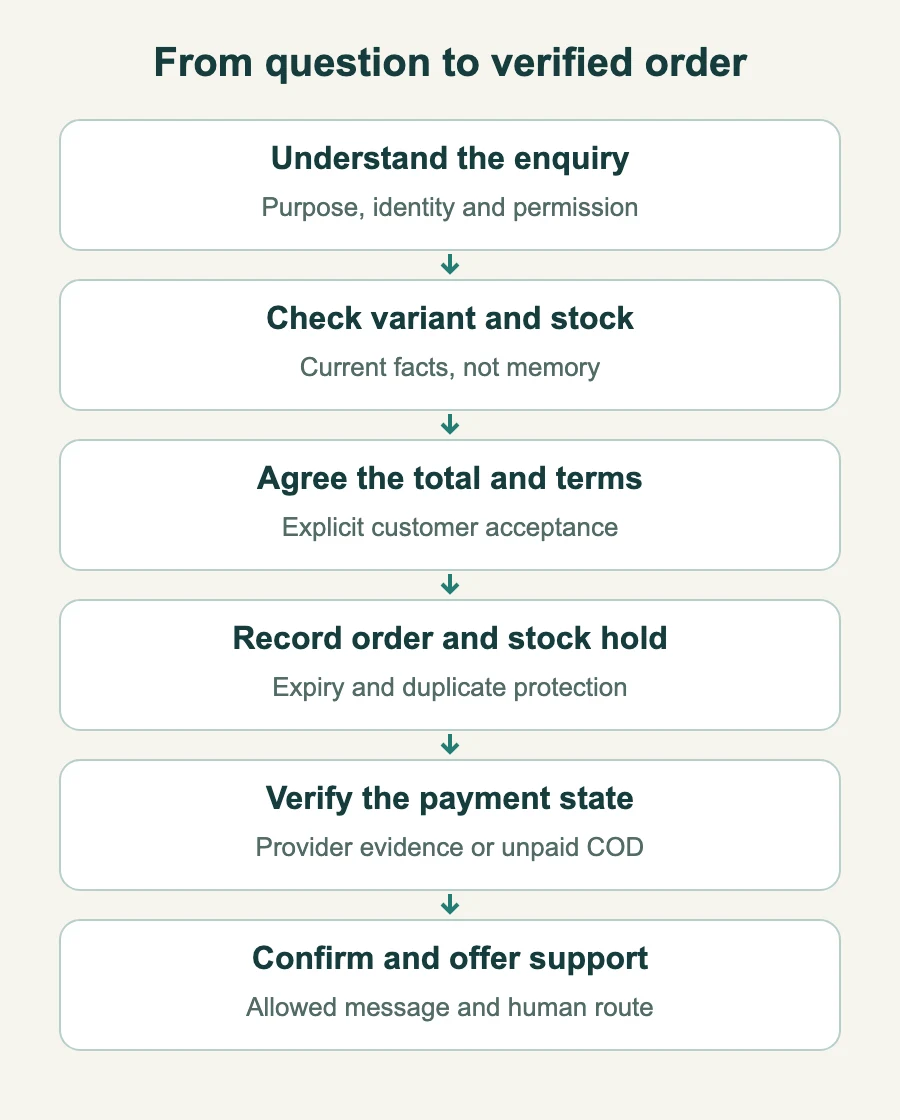
Use these six checkpoints, adapted to your business rules:
Enquiry and identity. Understand the question and permitted purpose. Use the channel identity carefully; collect delivery details when needed, not a full customer profile by default.
Product and stock. Confirm the variant, current selling price and eligible location. A read of availability is not itself a reservation.
Quote and acceptance. Show quantity, total, delivery cost, estimated timing and relevant terms. Let the customer review any transcribed address before accepting.
Order and reservation. Record the order at the agreed stage and reserve stock with concurrency protection. Define expiry, cancellation and duplicate-request handling.
Payment evidence. Use the chosen method and show the actual state. A COD order can be accepted while unpaid; a delayed payment after stock-hold expiry needs review.
Confirmation and support. Send the correct reference and state through an allowed message. Track delivery failures, offer a human route and send useful updates rather than every internal event.
Use the StoreConsole demo to rehearse order entry, stock and payment records. Separately confirm the specific chat connector, provider contract, account permissions and supported messages before agreeing an end-to-end integration. A shared platform still needs correct identity mapping, reservation rules and access controls.
WhatsApp checks for a 2026 rollout
The WhatsApp Business App and Business Platform are different products. Choose the setup after checking the account’s supported workflow, provider and API permissions. Do not infer an integration capability from a chat button or a feature list.
Opt-in
Record the recipient’s permission and the purpose of outreach; respect opt-out. A support enquiry is not blanket permission for unrelated promotions. Keep evidence of the choice rather than treating every button click as marketing consent.
The customer service window
WhatsApp’s policy permits replies without a template within 24 hours of a user message; another user message resets that window. Outside it, use an approved template for the permitted purpose. Content rules and account restrictions still apply.
Eligible ad or Page-CTA entry points can have a 72-hour pricing benefit. Check eligibility and the recorded start/end with your provider. A pricing benefit does not extend the separate free-form messaging permission.
Permission and pricing checklist
Utility, authentication and marketing templates serve different purposes; service is another message category in the pricing overview. The table is a routing checklist, not a tariff. Classify the actual message honestly and check its approval status.
Situation
Permission check
Budget check
Customer product question
Service-window eligibility and permitted content
Current account rules and provider charges
Order update after the window
Approved utility template where appropriate
Market, utility rate and applicable benefits
Promotion or restock campaign
Permitted outreach and marketing template where required
Effective marketing rate; check exceptions
Verification code
Permitted authentication flow and approved template
Authentication/international rates as applicable
Eligible ad/Page entry
Keep window and template checks separate
Confirm eligibility, benefit duration and provider fees
Budget from the effective rate card and provider contract: billable event, recipient market, category, currency, volume tier, applicable benefit, provider fees and taxes. Reconcile metered events with delivery records and invoices. Keep “may we send this?” separate from “what will it cost?”. Do not assume a marketing template always incurs a Meta charge or always has the highest applicable rate.
A note on AI
Use AI within the current terms for the provider, account and business use case. Record which data reaches the model, retention settings and how an authorised person takes over. Do not present every customer-service bot as automatically exempt from all platform restrictions.
Instagram and Messenger need their own checks
Instagram and Messenger have their own permissions, windows and supported message types. Check each connector’s current documentation; do not transfer WhatsApp template or pricing rules across channels. Preserve the product or campaign reference so staff can identify the customer’s question.
Keep essential order, preference and consent evidence in a governed system. Export only information you are entitled to retain, limit staff access and define retention. A full inbox export is not automatically an unrestricted marketing list.
Payment: link or cash on delivery
Attach payment evidence to the order. For a provider payment, verify the source, order reference, amount, currency and status. Keep authorised, captured, failed, refunded and settled states distinct. Duplicate callbacks must not create a second payment or order.
Payment link: show the agreed total and order reference. Verify provider evidence and handle expired links, short payments, duplicate notifications and refunds. A link alone does not eliminate fraud or reconciliation.
Cash on delivery: record an accepted but unpaid order, delivery evidence and the amount due from the courier. Match remittances, fees and adjustments later. Dispatch confirmation and cash settlement are separate events.
If you require a deposit, explain the amount, balance and cancellation/refund terms before acceptance. Apply the published policy consistently. A chat “YES” or an advance is useful evidence of a choice, not a guarantee against failed delivery or disputes.
Where AI helps, and where a person takes over
AI can assist with approved, low-risk facts when source data is current and access is scoped. It must not infer a customer’s private order from a guessed number or invent a price when a lookup fails. Use a clear pending state and an accountable human route.
Task
Accountable handling
Control
Public FAQ
AI assistance from approved sources
Keep policies current and provide a human route
Price and availability
Scoped catalogue lookup
Recheck at reservation; do not guess
Private order status
Verified customer and authorised lookup
Return only that customer’s permitted information
Address or discount change
Authorised staff or a bounded approved policy
Validate state, limits and audit evidence
Complaint or refund
Authorised person with a clear queue
Empathy, decision authority and minimal handoff data
Outage or uncertain answer
Visible pending state and operator
Bounded retry; no duplicate transaction
Treat customer messages as untrusted input, not permission to bypass business rules. Enforce identity, order ownership, discounts and refunds on the server. Send only relevant, permitted context to authorised staff at handoff; do not forward secrets or another customer’s thread.
The numbers to track
Choose explicit cohorts and time windows. Count conversations, customers and orders separately. Start with the following measures and link them to a decision:
Conversation conversion: eligible conversations with at least one accepted order ÷ eligible conversations × 100. Document duplicates, spam exclusions and the conversion window.
Meaningful response time: report median and a tail measure, such as p90; distinguish a useful response from an automatic acknowledgement and state staffed hours.
Order value: use the net value of qualifying chat orders divided by those orders, with the same exclusions when comparing channels.
Status enquiries: track eligible orders that generate a delivery-status question. Investigate late parcels, unclear promises and message delivery; a high rate does not prove one cause.
Outcome and cost: follow accepted, delivered, cancelled and returned orders, plus payment, messaging, AI and handling costs. Conversion alone is not profit.
Illustrative arithmetic: 72 of 400 eligible conversations result in at least one accepted order, giving an 18% conversation-conversion rate. A hypothetical 21% would mean 84 converted conversations. This is not proof that faster replies caused the change, or that the orders were delivered profitably. Compare similar cohorts and the costs of handling them.
Mistakes to avoid
Verify current stock and the complete quote before accepting a promise.
Use the right message purpose, permission and effective pricing; honour opt-out.
Retry failed messages with bounded backoff and visible ownership. Recheck policy before retrying; a notification failure must not create another order.
After a payment or courier timeout, query the existing reference before repeating the operation.
Protect order lookups and retain only the handoff context an authorised colleague needs.
Test a sold-out item, a late payment, a duplicate callback and a human escalation before expanding automation.
Return to the grey lamp. A reliable stock check finds zero, so the operator does not promise that unit or request its payment. They can offer a verified alternative or ask permission for a restock notification. If money already arrived, it becomes a visible exception with an authorised resolution. No fictional order number is created merely to tidy the chat.
Key takeaways
Chat can be the entry point; order, stock and payment need controlled records.
Ask for explicit acceptance of the variant, total and delivery terms.
Sending permission and pricing are separate checks; validate current account rules.
Verify payment evidence and reconcile COD, fees and refunds.
Use scoped facts for AI and offer an accountable human route.
Measure completed outcomes and costs, not only conversations or accepted orders.
Sources and review
Reviewed 4 November 2026. WhatsApp’s public policy page is dated 23 September 2026. The linked official pages describe messaging permissions, categories and pricing; effective account/provider terms govern the actual setup. Worked figures and the lamp story are editorial examples, not promised results.
Anichur Rahaman is a software architect and the creator of StoreConsole. He designs commerce and ERP systems for growing businesses, with a focus on event-driven architecture, data integrity and self-hosted operations.



 E-commerce