Close the Month with Evidence: Faster Reconciliation, Clearer Decisions
A payout that matches is only one part of the close. Connect bank evidence, sub-ledger balances and reviewed adjustments without forcing legitimate differences to zero.
Auteur
Anichur Rahaman
il y a 1 mois7 min de lecture140 vues
At 6:40 pm, a three-person finance team is looking at a bank credit of 9,712.40. No invoice has that amount. The tempting shortcut is to choose enough invoices to make the total fit. The useful question is different: which settlement does this credit actually belong to, and what evidence explains every component?
This is a teaching example, not a customer result. A faster close comes from collecting that evidence during the month and keeping a clear owner for each unresolved item. It does not require pretending that a bank match, an accounting entry and a financial review are the same task.
Follow the payout, not a convenient total
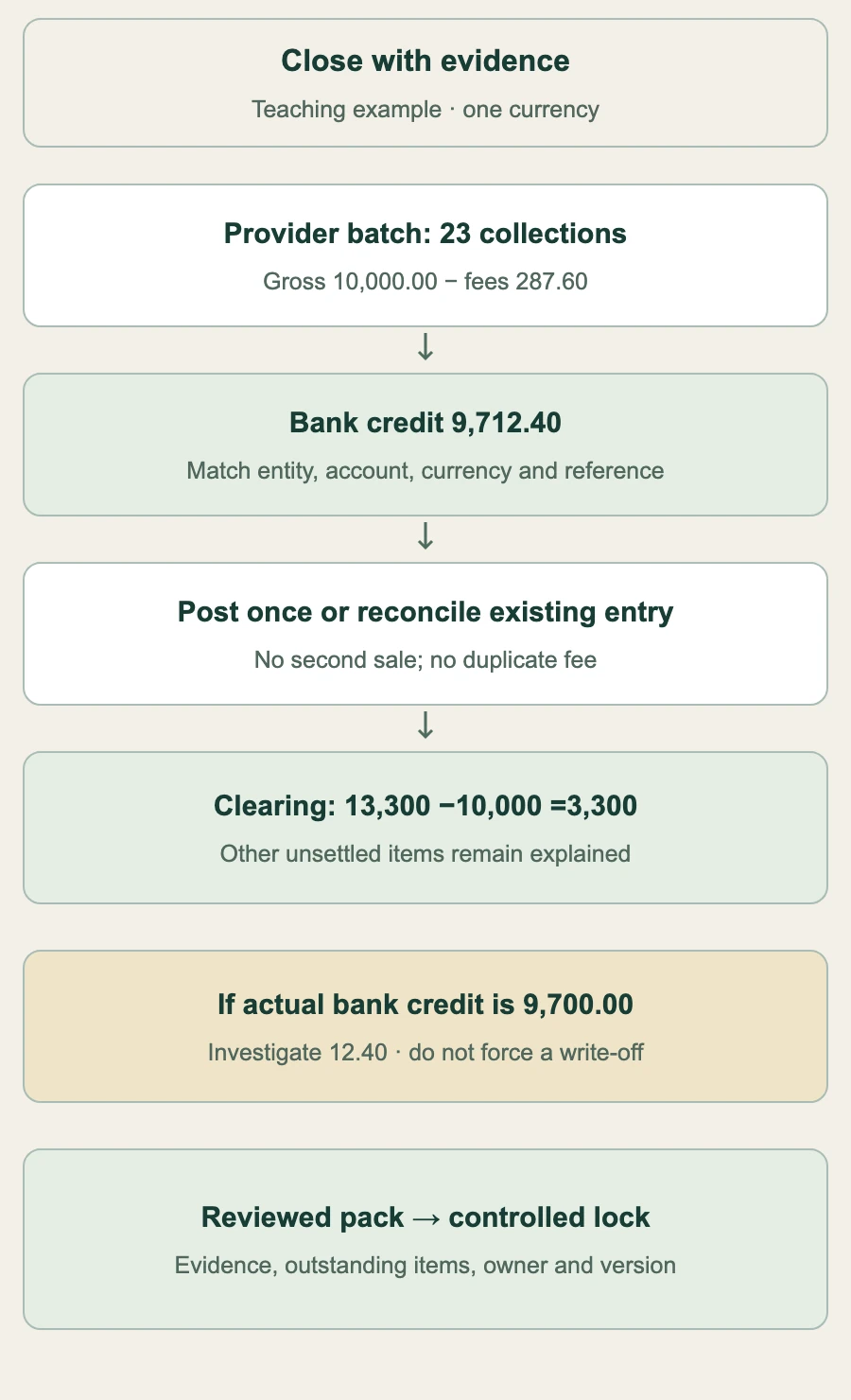
Assume one currency and a documented batch of 23 customer collections totalling 10,000.00. These collections already sit as a debit in gateway clearing; the fees have not yet been booked. The settlement report shows fees of 287.60 and a bank payout of 9,712.40. For this simplified example there are no refunds, reserves, disputes, FX or other adjustments.
The settlement entry below is balanced. It transfers an existing gateway receivable to bank and recognises the unbooked fee. It does not record revenue again. If fees or the payout were already posted by another integration, reconcile those entries instead of duplicating them. If the money is still in transit at cut-off, apply the approved cash-in-transit policy rather than inventing a bank receipt.
Account
Debit
Credit
Bank
9,712.40
Gateway fee expense
287.60
Gateway clearing
10,000.00
Stripe’s payout reconciliation guide is one provider-specific example: batch reports cover automatic payouts, while manual or instant payout reconciliation needs a different approach. Use your provider’s actual transaction detail and reporting boundaries; do not reconstruct every settlement from a guessed percentage.
If the bank instead shows 9,700.00, the unexplained difference is 12.40. That is a discrepancy to investigate, not automatically a fee or a write-off. Match the legal entity, provider account, currency, batch/reference, components and timing. Record supported rounding tolerances explicitly; never use a tolerance to hide a missing transaction.
A healthy clearing account may have a balance
Suppose gateway clearing held 13,300.00 before this settlement. Removing this 10,000.00 batch leaves 3,300.00 of other documented unsettled collections. That balance is not evidence of missing cash by itself. Reconcile opening balance plus movements to closing balance, then explain each outstanding item and its age.
The same principle applies to bank reconciliation: statement balance and cash-book balance can differ for supported timing items. Confirm statement completeness, account ownership, date range, opening/closing balances and the ledger cut-off. An imported feed with gaps can produce convincing matches while omitting transactions.
A sales total is not a receivables control balance. In a separate example, opening receivables 20,000 plus credit invoices 12,000 minus credit notes 500, allocated collections 10,000 and authorised write-offs 200 gives closing receivables 21,300. Compare the detailed customer balances to the corresponding general-ledger control account using the same entity, currency treatment and date. Investigate direct journals and unposted items; do not force a plug entry.
Inventory valuation, payroll liabilities, courier balances and tax accounts need their own tie-outs. Local recognition and tax policies matter. Under IFRS 15, revenue follows satisfaction of the performance obligation, not simply an order or payment event. Automate the approved accounting event, not every operational status.
Illustrative controls: verify the batch, avoid duplicate postings, explain the remaining balance and approve a traceable close version. Unresolved items keep their owner.
Use versioned rules for unambiguous exact matches and evidenced settlement groups. Repeated amounts or similar descriptions can still produce several candidates. A proposal should show its source, alternatives and reason; an AI confidence score alone is not authority to post or proof that the probability is calibrated.
An illustrative 1,000 eligible bank lines might leave 880 completed by validated rules, 70 suggestions awaiting approval and 50 other exceptions. Auto-completed share is 88%; 120 remain unresolved. Suggestions are not completed matches. These figures are not a benchmark or a promised saving.
Review a risk-based sample of automatic matches as well as exceptions. Track wrong matches, missed items, value and age, rather than chasing the highest match percentage. Changed bank details, unusual counterparties, sensitive accounts and high-risk adjustments can need independent review even below a money threshold.
Separate statement import, matching and posting identities. Re-importing a file or receiving a duplicate event must not create another journal. Recover failed integrations with bounded backoff and a visible owner; an unknown bank/provider result requires enquiry against the original reference before another financial instruction. Never mark a reconciliation completed just because a job ran.
Move dependable work forward; leave judgement with finance
During the month, reconcile available statements, resolve missing references, tie out sub-ledgers and check failed postings. Keep a documented source-to-ledger bridge and a recoverable posting queue. A “live” dashboard can still lag the source when a job fails.
Accruals, prepayments, depreciation, impairment, tax and foreign-currency work depend on the entity’s reporting framework and approved policy. A simple annual 1,200 insurance benefit spread evenly across 12 months gives 100 monthly expense; that is an example, not a rule for every contract or partial month.
For a service received by period end, assume a supported 600 accrual, not yet reversed. A 620 invoice confirmed during this close can settle the 600 accrued liability plus 20 additional expense against 620 payable. If an automatic reversal has already occurred, the posting route changes. Track the original accrual, reversal and invoice together so the expense is neither doubled nor omitted.
Do not treat invoice date, shipping label or bank date as a universal cut-off. Review when goods/services and obligations belong in the books under the relevant terms. IAS 10 distinguishes evidence of conditions existing at reporting date from later conditions for financial statements before authorisation. An internal monthly lock is not that authorisation date or a reason to ignore later evidence.
Use a calendar of evidence gates
The calendar below is a possible sequence, not a four-day service promise. Completeness and unresolved risk determine sign-off. Dependencies, holidays, provider delays and entity complexity can change dates; every task needs an owner, reviewer, evidence and escalation path.
When
Evidence gate
Accountable roles
During month
Complete feeds; reconcile and age differences
Preparer; independent reviewer
Cut-off / day 1
Confirm source completeness and recognition boundaries
Operations + accountant
Day 2
Support estimates and controlled adjustments
Accountant; approver
Day 3
Tie out controls and review unresolved risk
Finance reviewer
Day 4 or when ready
Approve pack/version; lock; brief management
Authorised finance owner
Do not circulate unrestricted payroll, bank exports or customer documents through task descriptions or AI prompts. Apply authorization on every request and to attachments/exports, scoped by entity and role. Preparation, rule changes, journal approval and final sign-off should have independent checks; where staffing makes separation difficult, document a specific compensating review.
Lock a reviewed version, then correct transparently
A close pack should identify its ledger cut-off, reconciliations, approved journals, outstanding timing items, estimates, review notes and report version. Balance-sheet balances need evidence as well as a balanced trial balance; equal debits and credits alone do not prove completeness or correct classification.
Restrict backdating and reopening. If a correction is needed, keep its reason, approver, affected reports and replacement version. Materiality is assessed in context, including qualitative factors; it is not permission to deliberately hide small errors. IAS 8 distinguishes new estimates from errors and generally requires retrospective correction of material prior-period errors unless impracticable. The finance owner applies the relevant framework, not an automatic “put everything next month” rule.
Measure elapsed time using a fixed start/end and working- or calendar-day basis, along with aged/value-weighted exceptions, posting lag, sampled match quality and necessary corrections. A zero post-close-adjustment target can discourage honest correction; explain causes and improve the process instead.
Start with one well-understood account. Run proposed rules in shadow mode against a trusted reconciliation without double-posting, test duplicates and failures, review the results and expand deliberately. The team at 6:40 pm is finished when it can explain the payout and the remaining balance—not when every row is green.
Existing product interface tour. It illustrates screens, not reconciliation accuracy or a promised close time.
Reviewed 5 November 2026. Anichur Rahaman, creator of StoreConsole. Examples are illustrative; apply the entity’s reporting framework and approved accounting policies.



 E-commerce