Connected Payroll: From Approved Hours to Money Actually Paid
A payroll calculation, an accounting entry and a bank transfer are different outcomes. Join the records without losing pay rules, privacy or control.
Auteur
Anichur Rahaman
il y a 3 mois9 min de lecture139 vues
It is the 29 th. A retailer’s finance manager has an attendance export, a leave sheet, a commission report and a payroll workbook open. Two outlets say overtime is missing. A pay increase has the wrong effective date. Tomorrow’s bank deadline makes every discrepancy urgent. This nine-outlet, 140-person business is a teaching scenario, not a reported customer result.
A connected system can remove repeated typing and make each decision traceable. It cannot turn an unapproved timesheet into lawful overtime or a prepared bank file into money received. The useful goal is one accountable record of each fact, with clear boundaries between calculating, recognising a liability and paying it.
One employee identity; several owners of the facts
HR owns effective-dated employment and pay terms. Timekeeping owns submitted and approved hours. Leave management owns entitlement and approved absences. The commission policy defines eligible transactions, attribution, returns and reversals. Payroll owns a versioned calculation; finance owns account mapping and recognition policy. Treasury owns payment instructions and their confirmed outcomes.
These can be modules in one product or carefully integrated specialist tools. A single product is not proof of correctness, and integration does not mean that every module writes to the employee master or sees every salary. Stable employee and employment identifiers link the records; scoped interfaces and controlled snapshots move only the necessary facts. Keep history rather than replacing last month’s pay terms with today’s values.
A missing punch is an exception to investigate, not automatic unpaid leave. An overtime request needs the applicable classification, working-time rules and approval. Commission needs an agreed base: booked, collected or otherwise eligible sales, tax treatment, discounts, cancellations and later returns. An order total alone does not settle those questions.
Before calculation, define the period and resolve the exceptions
Record the employing entity, currency, pay period, time zone, pay date, applicable rules and their effective versions. Reconcile the expected population: joiners, leavers, transfers and people with zero or negative pay need explicit treatment. Verify bank-detail changes through an independent trusted channel; a familiar email address is not sufficient evidence.
Set a cutoff for approved hours, leave and variable pay, then create a reproducible input snapshot with source references. A cutoff prevents silent mutation; it does not extinguish wages earned after it. Work after cutoff, retroactive increases and corrections need a defined supplemental or later adjustment process that meets the actual payment obligation.
Employment rules are local and contractual. The ILO’s wage guidance explains safeguards around regular payment and deductions; it is not a universal payroll rate table. Validate the actual jurisdiction, agreements and employee classification. US IRS Publication 15 for 2026 illustrates why outsourcing generally does not remove an employer’s federal employment-tax responsibilities, subject to arrangement-specific exceptions. Those US duties are not global rules.
A worked employee: assumptions first, arithmetic second
All amounts below are USD purely as a teaching unit. Assume an approved monthly policy with 20 scheduled eight-hour days,160 hours, base pay 3,000.00,10 eligible overtime hours at 1.5 times the 18.75 hourly base, and 2 approved unpaid days at 150.00 each. Eligible commission sales are 40,000.00, excluding tax and returns under this example’s policy; commission is 2%.
For arithmetic only, invent withholding of 10%, employee contribution 5% and employer contribution 8% of gross. These are not any country’s statutory rates, minimum-wage test or overtime formula. Use decimal arithmetic and round each contribution/withholding line to two decimals, half up; the real payroll may require different bases, caps, rounding and year-to-date calculations. No other benefits, arrears, garnishments or deductions are included.
Component
Illustrative calculation
USD
Base pay
Contract / 3,000.00
3,000.00
Overtime
10 × (3,000 ÷ 160) × 1.5
+281.25
Commission
40,000 × 2%
+800.00
Unpaid leave reduction
2 × (3,000 ÷ 20)
−300.00
Gross pay
3,000 + 281.25 + 800 − 300
3,781.25
Tax withheld
3,781.25 × 10%
−378.13
Employee contribution
3,781.25 × 5%
−189.06
Net pay
3,781.25 − 378.13 − 189.06
3,214.06
Employer contribution
3,781.25 × 8%
302.50
The ledger records an obligation; approval does not create the service
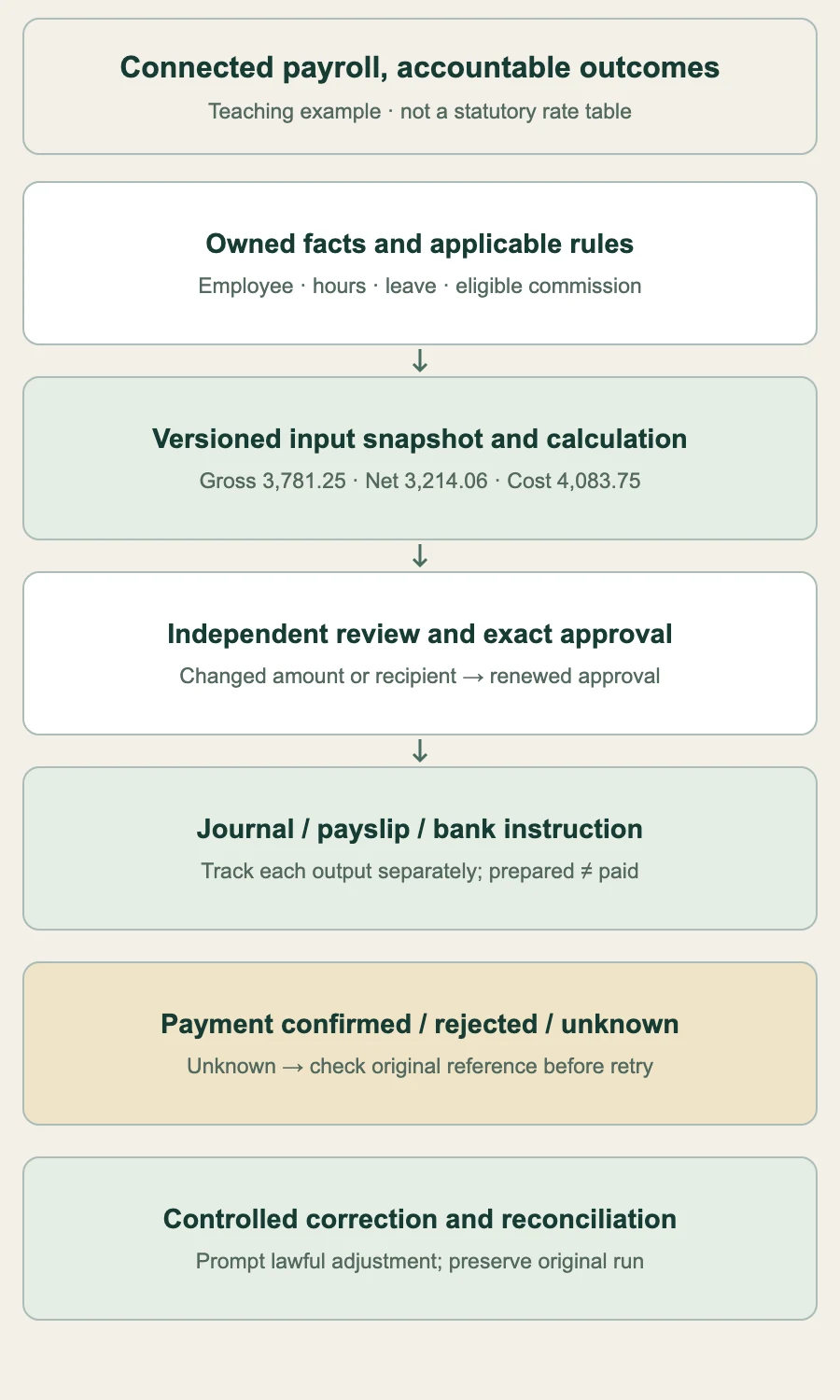
Gross pay is 3,781.25 and net pay 3,214.06. The employer’s assumed additional contribution is 302.50, giving total example cost 4,083.75. Employer contribution increases cost; it is not deducted from net pay. Employee withholding remains a liability to remit, not extra employer expense.
IAS 19’s overview links benefit accounting to employee service where IFRS applies. Finance sets the recognition period and treatment, including accruals, asset costs and true-ups. The following simplified entry assumes all illustrated cost is this period’s expense and none was already accrued. If a prior accrual exists, reconcile and adjust it; do not post the same cost again merely because payroll was approved.
The illustrative entry balances at 4,083.75 on both sides. Split expense by the cost centre that actually benefited under an approved allocation, not necessarily the employee’s current outlet. A balanced entry can still have wrong employees, rates, accounts or period. Link it to the approved run version and prevent a repeated posting request creating another journal.
Account
Debit USD
Credit USD
Basic salary expense
2,700.00
Overtime expense
281.25
Commission expense
800.00
Employer contribution expense
302.50
Net salaries payable
3,214.06
Tax withheld payable
378.13
Employee contribution payable
189.06
Employer contribution payable
302.50
Total
4,083.75
4,083.75
Give each output an honest state
Calculation approved, journal posted, payslip issued, bank instruction submitted and payment confirmed should be distinguishable. Database writes, a ledger integration, email and a bank are not one atomic action just because a screen has one button. Track obligations and recover each failed output without regenerating all successful effects. Payslip timing must follow applicable rules, not an invented requirement that email and ledger finish simultaneously.
For this example, once the bank debit/payment evidence supports the approved policy, debit Net salaries payable 3,214.06 and credit Bank 3,214.06; a real workflow may use payment clearing before settlement. Generating a file alone posts no proof of payment. Tax and contribution liabilities remain until separately remitted and reconciled.
Keep a durable payment reference per intended employee payment and check provider/bank-supported duplicate controls. An upload timeout is unknown, not necessarily rejected. Query the original reference or reconcile bank evidence before resubmitting. Use bounded retries with backoff, attempt/age limits and a named owner. Never resend the whole payroll batch because one person’s transfer failed; retain successful results and investigate the affected items.
Connected does not mean simultaneous. Preserve one approved run and separately prove each accounting, employee and bank outcome.
Correct pay promptly without rewriting the approved history
A draft can be recalculated. Changing pay, recipient details or inputs after review invalidates the affected approval and requires a new version. Preserve the released snapshot, reason, authorisation and linked adjustment/reversal instead of silently rewriting it. OWASP’s transaction-approval guidance supports binding authority to the actual significant transaction data.
A missed amount may require an off-cycle payment or an amended filing/payslip, not an automatic wait until next month. Decide using local deadlines and the employee’s rights. Recovering an overpayment can have consent and legal limits; do not invent an automatic deduction. Keep the original payment, correction, accounting effect and statutory submission linked.
Exception review should include joiners/leavers, missing or duplicate staff, unusual pay changes, changed bank details, negative net pay and unexplained totals. Also reconcile every employee’s calculation and the run totals, and sample apparently unchanged records. Looking only at high percentage changes can miss a duplicated employee or a consistently wrong rule.
Make privacy and independent review part of the design
Separate changing pay terms, reviewing the run and authorising payment where staffing permits. Two logins belonging to one person are not independent approval. A small team needs a documented compensating review and controlled bank process, not an unrecorded superuser bypass. Finance staff may need individual detail for a justified duty; access should follow that duty, entity and record scope rather than a universal job-title rule.
OWASP’s authorisation guidance recommends least privilege and permission checks on every request. Apply these to employee self-service, direct payslip downloads, exports, APIs, background work and AI tools. A random record ID or hidden button is not authority. Managers need approved team scope, not automatic access to everyone’s bank account, health information or pay.
Restrict exported bank files, downloads and backups; encrypt and retain them according to actual obligations and revoke stale access. Record who changed or exported data without putting full bank details or salary documents into general logs. Shared calendars should expose an authorised deadline or count, not leak named salaries to people who can see only a calendar.
Prove a safe transition, then retire the spare spreadsheets
Configure roles, bank controls and account mappings before using real payroll data. Clean employee/employment identities, effective dates, opening balances and cumulative tax/contribution values. Then shadow-calculate representative periods, including a joiner, leaver, retroactive change, unpaid leave and rejected transfer. Compare earnings, each deduction, employer cost, net pay, liabilities and cost-centre allocations per person and in total.
Choose the number of rehearsals from coverage and explained differences; one calendar month is not universal proof. Only one process releases real payments or statutory submissions. Keep the alternative calculation isolated from those effects, define the first authoritative run, and test recovery before retiring the old payment route.
Measure timeliness against the contractual due date, confirmed unpaid/unknown payments, reconciliation gaps and distinct payslips needing error correction. Separate corrections from legitimate later adjustments. Track manual handling time without promising a saving. Payroll cost divided by outlet net sales is a labour-cost ratio, not the currency cost of staffing an outlet.
In the opening scenario, a better evening ends with resolved exceptions, an approved immutable run and a visible list of remaining obligations. Ask a software supplier—including StoreConsole—to demonstrate those actual journeys, permissions and failures in the offered version and enabled modules. A polished demo is a starting point for that proof, not a guarantee that every local rule is already configured.
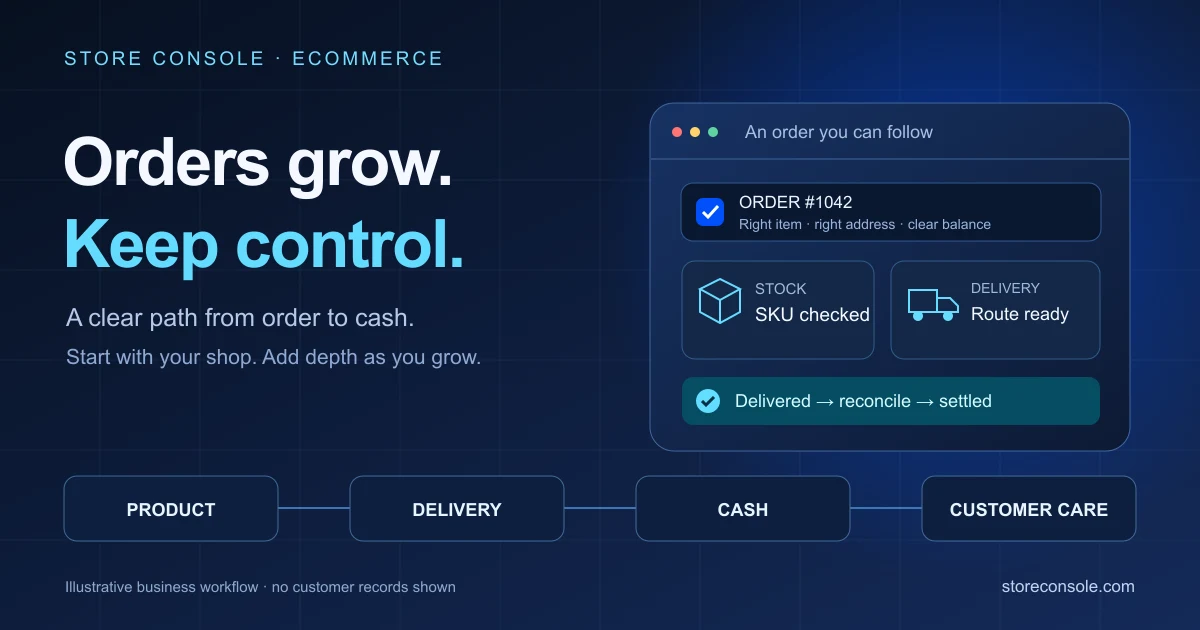
Existing StoreConsole payroll demonstration, retained for product context. Verify the offered version, configured rules and failure handling separately.
Reviewed 5 November 2026. Anichur Rahaman, creator of StoreConsole. Business story, rates, calculations and controls are teaching examples; local employment, tax and accounting policy determine the real run.



 E-commerce