Returns Management: Follow the Jacket, the Refund and the Real Margin
See what returns do to contribution, build a fair refund process and route inspected stock correctly, with a complete 40-jacket worked example.
Auteur
Anichur Rahaman
il y a 1 mois8 min de lecture139 vues
On Monday, a shop owner sees forty jacket sales on her report. At 80 currency units each and a cost of 44, the gross margin looks like 1,440. Then she turns to eight returned jackets beside the packing desk. One asks for a size exchange; another customer is still waiting for a refund update.
The scene and figures are illustrative, but the management question is useful: what did this group of orders actually contribute after refunds, shipping and recovery costs? The answer will not come from the sales counter alone. Someone has to follow both the customer’s remedy and the item’s next destination.
A good returns process makes those two journeys visible. It gives the customer a clear next step, keeps unchecked goods out of saleable stock and shows the buyer which products need attention. Here is how to build it without turning every return into a dispute.
Start with one complete group of orders
For a clean calculation, freeze a cohort of forty one-jacket orders after its chosen return-observation period. Assume eight full refunds and eight items received; the exchange mentioned in the opening is not included in this all-refund scenario. Prices exclude tax, customers paid no separate delivery charge, and every original order incurred the stated shipping and payment costs.
Each jacket originally cost 44. Assume the returned items are recovered at that cost, then an average write-down of 12 per returned item reduces their carrying value to 32. This is an assumed inventory impairment, not a retail discount counted again as a loss. The remaining returned inventory is worth 8 × 32 = 256; no later resale revenue is counted in this cohort.
Cohort line
Calculation
Units
Original goods sales
40 × 80
3,200
Full refunds
8 × 80
-640
Net goods sales
3,200 − 640
2,560
Cost of the 32 retained jackets
32 × 44
-1,408
Outbound shipping on all 40 orders
40 × 8
-320
Original non-returned payment fees on all 40
40 × 2.60
-104
Return shipping
8 × 9
-72
Receiving and handling
8 × 4
-32
Return-related support
8 × 3
-24
Inventory write-down
8 × 12
-96
Contribution after listed costs
2,560 − 1,408 − 320 − 104 − 72 − 32 − 24 − 96
504
The listed contribution is 504: 2,560 − 1,408 − 320 − 104 − 72 − 32 − 24 − 96. It excludes rent, marketing, tax and other unlisted costs, so it is not net profit. A hypothetical no-return case under the same assumptions contributes 1,016; the difference is 512, not a measured forecast of future losses.
Another check: each of the 32 retained orders contributes 36 − 8 − 2.60 = 25.40. Each refunded order contributes −38.60 in the listed shipping, fees, handling, support and impairment. Thus 32 × 25.40 − 8 × 38.60 = 504. Counting outbound freight only on returns would omit a real cost of the other orders.
Replace every allowance with your own evidence. Retained fees depend on the provider contract; Stripe’s refund documentation, for example, says original processing fees are not returned and describes pending/failed states. Inventory valuation also needs a consistent policy; IAS 2 covers cost and net realisable value.
Write the promise before automating the decision
Publish the relevant window, how to request help, shipping responsibility, permitted remedy and expected next steps before purchase. Distinguish a change-of-mind offer from a defect, damage or wrong-item claim. Keep the policy version associated with the order. A “final sale” label does not automatically remove statutory rights.
Map applicable consumer rules to the actual market, product and claim. A single “take the longer number of days” rule cannot resolve every right, exception or deadline. As one jurisdictional example, see Your Europe’s separate guidance on withdrawal/returns and defective-goods guarantees.
Present the options the customer is entitled to without a maze. An exchange may solve a size problem, but it requires stock, any price difference and another fulfilment decision. Store credit is an obligation to the customer, not new profit; do not force it in place of a refund that is due. The direction of policy effects on conversion and returns must be tested, not assumed.
Run the customer and item journeys in parallel
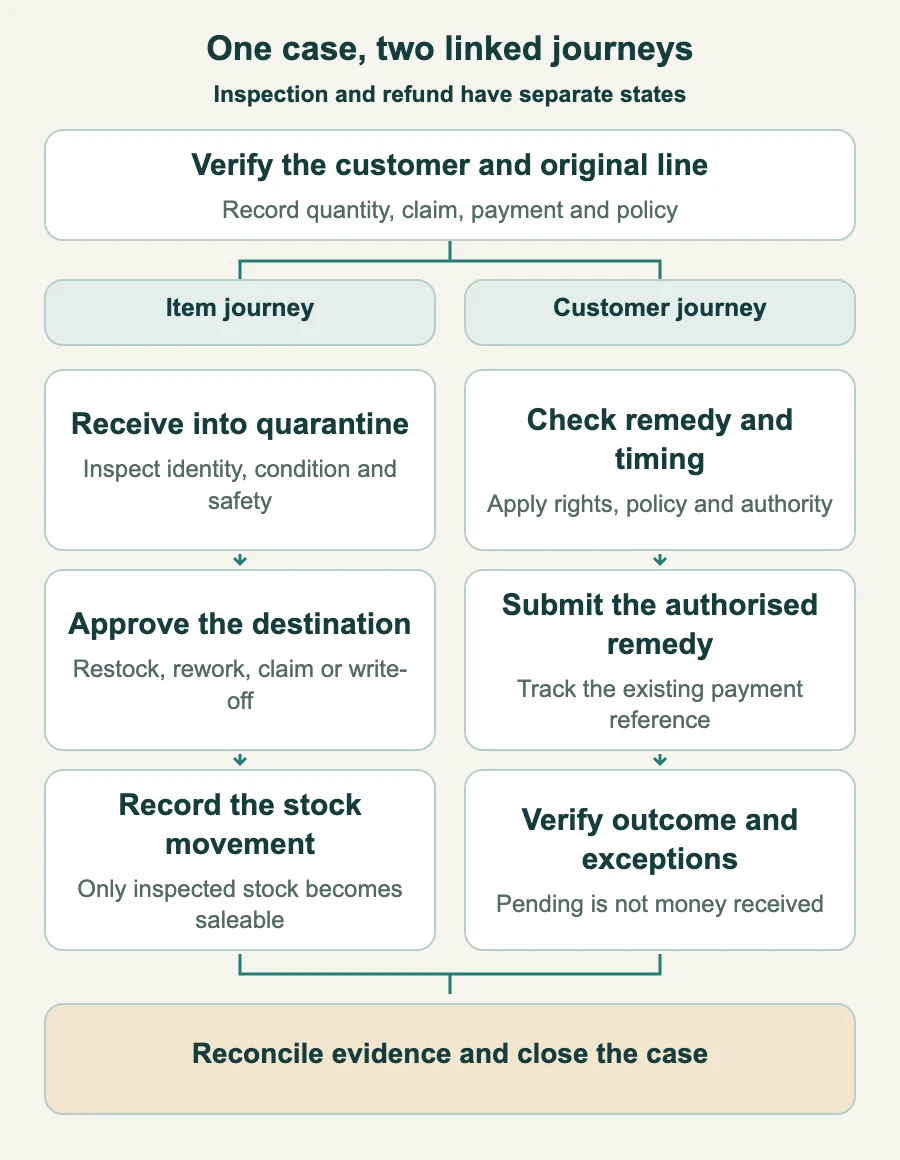
Open a case linked to the original order line, quantity, price, discount and payment. Verify identity and access; staff should see only the records their role permits. Record the claim separately from the eventual inspection result. A request, an accepted remedy and a successful refund are different facts.
The item journey: receive into a non-saleable returns status, check quantity and identity, inspect condition and safety, then authorise the destination. Restock only when genuinely saleable; rework when the expected recovery justifies the cost; use an honestly described open-box listing where appropriate. Supplier claim, recycling or write-off needs an accountable owner and evidence. A label or tracking scan alone does not restore stock.
The customer journey: determine the applicable remedy and timing, obtain the required approval and communicate progress. Do not require warehouse receipt in every case: the permitted timing depends on the actual obligation and process. For refunds, verify the payment reference, amount, currency and any existing refund/dispute. Use the original method where required/supported, with a verified exception route if it fails.
A courier or payment timeout leaves an unresolved state. Check the existing reference before repeating the action; use bounded retries with backoff and a visible case owner. A second click must not issue another label, reservation or refund. An exchange needs its own stock reservation and traceable order movement.
The item and customer paths share a case, not an automatic rule that one must always wait for the other.
Use return reasons to ask better questions
Start with useful customer reasons: too small, too large, not as described, damaged, defective, wrong item and change of mind, plus an “other” note. Preserve the customer’s account and the later inspection finding separately. Customers should not have to choose an inaccurate reason to submit a claim.
Suppose five of the eight jacket returns say “too small”. That is a signal to investigate the affected sizes, supplier measurements, product copy and picking accuracy. It does not prove the chart is wrong or the customer is wrong. Compare against the sold-size mix and a mature observation window.
Check the product page against the item: measurements, fit notes, colour, scale, materials and what the parcel includes. Inspect packaging and carrier evidence for damage patterns. Test a change, then compare similar cohorts and margin; no copy fix permanently eliminates returns.
Check suspicious cases fairly
A serial mismatch, empty parcel or repeated duplicate request can justify review. A high return rate alone is not proof of fraud; bracketing sizes may be a legitimate shopping choice. Apply proportionate checks, consistent decisions and an accessible appeal route. Do not punish an account simply because a model assigns a risk score.
Where justified, record condition, parcel weight or serial/batch evidence with a named reviewer. Collect only what is needed, mask unrelated address labels when sharing evidence, limit access and retention, and protect staff/customer information. Photos and weights help investigate; they do not establish intent by themselves.
For context, the NRF/Happy Returns 2025 study estimated 19.3% of US online sales would be returned. That historical survey estimate is not a rate for your orders or a global 2026 benchmark.
Reconcile the order, stock and money
Keep the case, stock movement, credit/refund and payment reference linked. Allocate original discounts, tax and delivery adjustments under the applicable rules; partial returns and bundles need explicit calculations. A refund cannot simply assume every charged component reverses identically.
Record recoverable inventory and any impairment without charging the same loss twice. An exchange has both a return and a new fulfilment; gift credit remains a liability until appropriately recognised. Agree accounting mappings with the finance owner rather than assuming an automation event guarantees correct books.
Reconcile case amounts with provider status and ledger entries. Match timing differences, retained fees, pending/failed refunds and disputes; daily totals need not match while items are still in flight. Keep an exception list with an owner and age, and close cases only after the required evidence is present.
Measure the outcomes that stay hidden
Mature return rate: returned units ÷ delivered units in the same eligible cohort and observation window. Report value rate separately, with an explicit denominator; do not mix this week’s returns with this week’s unrelated sales.
Contribution and cost: show net sales, retained cost of goods, ordinary fulfilment and incremental return costs. Distinguish cash spend, allocated labour and inventory impairment.
Customer timing: measure request, authorisation, refund submission and confirmed payment outcome separately, including open overdue cases. A quick API response is not the customer receiving money.
Recovery timing/value: track receipt-to-inspection and receipt-to-saleable stock; actual resale is another event. Define whether recovery means inventory carrying value, resale proceeds or proceeds net of recovery cost.
Reasons and fairness: review reasons, grades, appeals and error patterns by product/variant/channel. Aggregate trends help; prioritise by cost and harm as well as returned value.
What changes at the packing desk
Back at the packing desk, the owner can separate a customer’s request from a warehouse decision and a provider’s payment status. Five “too small” reports become an investigation, not an accusation. The buyer sees the cohort’s 504 contribution under the stated assumptions and the remaining inventory value, rather than treating 1,440 of initial gross margin as spendable profit.
Start with one category: map the customer’s choices, agree inspection routes, reconcile a complete cohort and fix one evidenced cause. Expand when the people doing the work can explain each step. A trustworthy process earns its value in fewer unresolved cases and clearer decisions, not simply fewer accepted returns.
Reviewed 4 November 2026. Anichur Rahaman is the creator of StoreConsole. The jacket story and financial model are illustrative; actual policy and costs depend on the business.



 E-commerce