 E-commerce
Starting an Ecommerce Business: Orders, Delivery and Cash Flow
Connect ecommerce orders, stock, delivery, COD payments and customer care. A practical story with AI chat, Social Hub and room to grow into ERP.
Anichur Rahamanhá 1 dia12min

Fix a conflicting jacket offer, publish answers buyers can use and measure AI visibility without turning a few mentions into a promise of sales.
Autor
Anichur Rahaman

Parte 2 de 3
Selling to AI AgentsThe jacket page says 129. The feed still says 159. The selected size is available on one surface and sold out on another. Imagine the shop owner asking an assistant for a waterproof jacket and not seeing hers. She has found a real data problem, but she has not proved why the assistant omitted it. This is the same fictional outdoor shop used in part 1, not a customer success story.
That distinction matters. Fixing the conflicting offer is valuable even if the next answer still recommends another jacket. You can verify the repair; you cannot promise a place in an answer you do not control.
Generative engine optimization, or GEO, is the common label for work intended to improve discovery and representation in AI-generated answers. For a store, the practical job is familiar: make useful product information accessible, consistent and credible, then observe what happens. Different assistants, search results and shopping cards are not one ranking system.
Search visibility has never been only a position for one keyword. A buyer may discover a product through an image, a review, a comparison, a merchant listing or an assistant’s explanation. Instead of “How do I force the recommendation?”, ask “Can someone understand this product, verify the offer and decide whether it fits their need?”
Google’s AI features guidance says ordinary Search eligibility applies; no special AI markup or file is required. Eligibility does not guarantee inclusion. This is Google’s guidance, not a universal policy for every assistant.
There is no public, universal four-stage pipeline in which every missing field automatically excludes a store. Incomplete or conflicting data can damage an offer and channel eligibility, but absence from one answer alone does not identify the cause. Record the actual failure before buying a proposed cure.
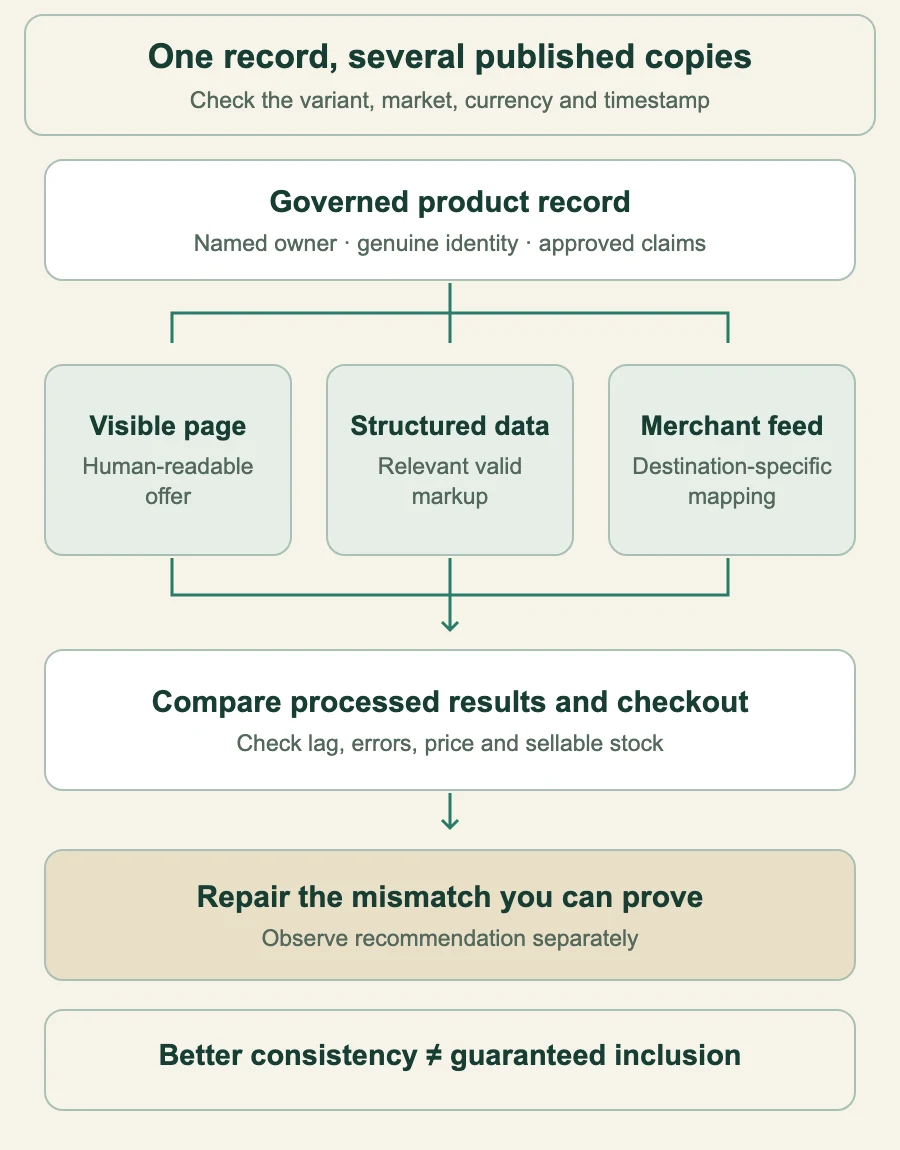
Choose the exact variant, market and currency first. A minimum “from” price for a different size is not the selected variant’s price. Check any promotion’s conditions, destination-dependent charges and the time of the observation. Compare visible page, structured data, submitted feed, platform-processed result and checkout; a successful upload is not proof that the latest version is displayed.
Give the source record an owner and an update history. Generate downstream representations from it, but monitor mapping bugs, delayed jobs and rejected rows. Shared origin reduces manual drift; it does not make every copy instant or correct. Reconcile a sample after a price or stock change, not only at launch.
Use a stable internal variant ID and genuine assigned external identifiers where applicable; never invent a GTIN or manufacturer number to satisfy a form. Keep real product images and supported specifications. Publish the limitations too: water resistance, fit and care are useful only when described accurately.
Build one useful category comparison around a real question: for example, commuting in light rain versus a long exposed hike. Explain which jacket suits each use, where it does not, which measurements support the comparison and whether the evidence is a supplier specification, an independent test or your own documented test. Do not turn a supplier claim into a test you never performed.
A compact specification table with units, clear photographs, sizing guidance, delivery conditions and a readable return policy helps a person judge the offer. Put important facts in accessible text as well as images. FAQs should answer actual customer uncertainty, not repeat every search phrase.
Google’s product structured-data documentation distinguishes product snippets and merchant listings. Choose the applicable requirements and validate the output; markup does not guarantee a rich result or AI recommendation.
Keep visible claims and structured values consistent. Only mark up genuine reviews and qualifying ratings you actually hold. Avoid purchased praise, invented experts or mass-produced comparison pages that say nothing new. If you update a page, change the review date only when the material has genuinely been reviewed.
Ask the technical owner to inspect the rendered page, canonical address, intended locale, indexing controls, crawl errors and any CDN challenge. A page that works in your logged-in browser may not be available to the intended discovery route. A sitemap is a discovery aid, not an indexing or recommendation guarantee.
OpenAI documents separate controls for OAI-SearchBot search crawling and GPTBot training crawling. Allowing search access does not require allowing training. Verify the intended crawler rather than disabling protection for every automated visitor.
Keep catalogue discovery separate from account, invoice and order access. robots.txt is not authentication. Never expose private data or weaken customer permissions to make the store “AI-readable”. A bot name in a request is not identity proof.
A feed is a channel contract, not one universal file. Check current programme eligibility, required and conditional fields, accepted format, variant rules and update status for each destination. Reuse your governed product records, with validated mappings. Do not assume one unchanged export enrols you in Google, ChatGPT, Perplexity and Copilot.
The llms.txt project remains a proposal and was revised in August 2026. Some agent/documentation workflows use such files; that is different from guaranteed search inclusion.
Google’s current optimization guide says Google Search ignores llms.txt for visibility and ranking. If another documented workflow needs it, maintain it for that purpose; it does not repair a stale price.
Prioritise the buyer’s broken facts and the destination’s actual requirements. A format conversion, an “AI-ready” badge or a file by itself cannot certify recommendation quality. Part 1 explains the changing shopping programmes; keep discovery work distinct from permission to buy.
Use the table below to assign each observation its proper meaning. Platform reports cover their own definitions and supported surfaces, not the entire AI market.
Google’s Generative AI performance report now documents Search AI impressions, with worldwide rollout from 31 August 2026; low impressions can hide the report. Check its own counting rules.
Bing’s AI Performance updates cover citations across supported Microsoft and partner experiences. Its Citation Share is observational, not a ranking, traffic share or quality score.
For a small, reproducible teaching example, take 20 buyer questions and run each three times in the same specified assistant, country and language: 60 responses. If 12 contain an explicit recommendation of your product, that is 20% of those sampled responses, not 20% market share. The runs are not necessarily independent. Record date, model or mode where visible, account context, citations, price accuracy and whether the product is merely mentioned or recommended.
Do not change the prompt set halfway through and call it improvement. Compare equivalent periods and record promotions, inventory changes and platform changes. Keep an unknown-source category in analytics, deduplicate transactions, separate crawlers from human visits and respect consent and retention requirements. An optional “How did you hear about us?” answer adds context, not precise attribution.
A citation is not a click; a click is not an accepted order; an accepted order is not settled revenue. Compare contribution after acquisition, support and returns, and use a suitable controlled test if you need an incremental-sales claim. A before/after screenshot cannot isolate causation.
| Observation | What it tells you | What it does not prove |
|---|---|---|
| Feed accepted | The submitted data passed that processing step | Every shopper sees the latest offer |
| Correct offer in a sample | Those checked variants agreed at that time | The whole catalogue is always correct |
| Citation or recommendation | A supported report or observed answer used the product/page | A visit, sale or universal ranking |
| Attributed accepted order | An order is linked to an available source signal | Settlement or incremental profit |
For the jacket, the first milestone is narrow: the selected variant’s current price and availability agree across the checked surfaces, the next update propagates as expected, and checkout revalidates the offer. Record remaining platform lag and errors. Then improve the product explanation and run the same observation set again.
You may learn that a better page is cited, that another product still fits the question better, or that the data is insufficient to draw a conclusion. All three are more useful than a guaranteed-ranking promise. The next article follows the shopper from a recommendation to an authorised, reconcilable purchase.
Part 2 of the AI shopping series: the merchant’s purchase routes → this discovery guide → checkout and delegated payments.
Reviewed 5 November 2026. Anichur Rahaman is the creator of StoreConsole. The shop and prompt experiment are illustrative, not measured client results.
Séries
Selling to AI AgentsSobre o Autor
Anichur Rahaman
Continuar Lendo