Ecommerce Contribution Margin: What Each Order Actually Leaves
A 100 sale can leave only 20 before fixed costs. Follow the order-level calculation, find missing costs and decide which sales are worth growing.
Anichur Rahaman3 minutes ago4min

Build a weekly cash view, then move one payout by a week. See how a growing store can run short before the sales report gives any warning.
Author
Anichur Rahaman
Part 5 of 5
Selling More, Keeping Less?Illustrative business and amounts, not customer results or market benchmarks. All amounts use one example currency; replace the assumptions with your own records.
Daniel's shop has a strong sales week and a supplier deposit due on Friday. Some customer payments are still with a courier or payment provider. Payroll cannot be paid with a sales-report total. The business needs a view of when money becomes usable.
A 13-week cash forecast is a short-term rolling planning view. It supplements the budget and accounts. It is not a promise of future balances, and thirteen weeks is a useful planning horizon rather than a legal requirement or a substitute for a longer funding forecast.
Choose one reporting currency and a consistent weekly cut-off. Start from available cash and bank balances, showing restricted amounts separately. Put expected customer receipts and courier or gateway settlements in the week they are expected to arrive, supported by payment terms and actual history.
List supplier payments, payroll, rent, refunds, advertising, tax payments and debt service by expected payment date. Keep financing and owner movements separate from trading receipts. Buying inventory is a cash outflow when paid; do not add cost of goods sold as a second cash payment for the same stock.
| Week | Opening cash | Cash received | Cash paid | Closing cash |
|---|---|---|---|---|
| 1 | 5,000 | 3,600 | 4,000 | 4,600 |
| 2 | 4,600 | 3,800 | 6,000 | 2,400 |
| 3 | 2,400 | 4,200 | 5,000 | 1,600 |
| 4 | 1,600 | 4,000 | 4,200 | 1,400 |
| 5 | 1,400 | 4,400 | 4,300 | 1,500 |
| 6 | 1,500 | 4,600 | 4,200 | 1,900 |
| 7 | 1,900 | 4,500 | 4,400 | 2,000 |
| 8 | 2,000 | 4,700 | 4,300 | 2,400 |
| 9 | 2,400 | 4,800 | 4,500 | 2,700 |
| 10 | 2,700 | 4,600 | 4,400 | 2,900 |
| 11 | 2,900 | 5,000 | 4,600 | 3,300 |
| 12 | 3,300 | 5,100 | 4,700 | 3,700 |
| 13 | 3,700 | 5,200 | 4,800 | 4,100 |

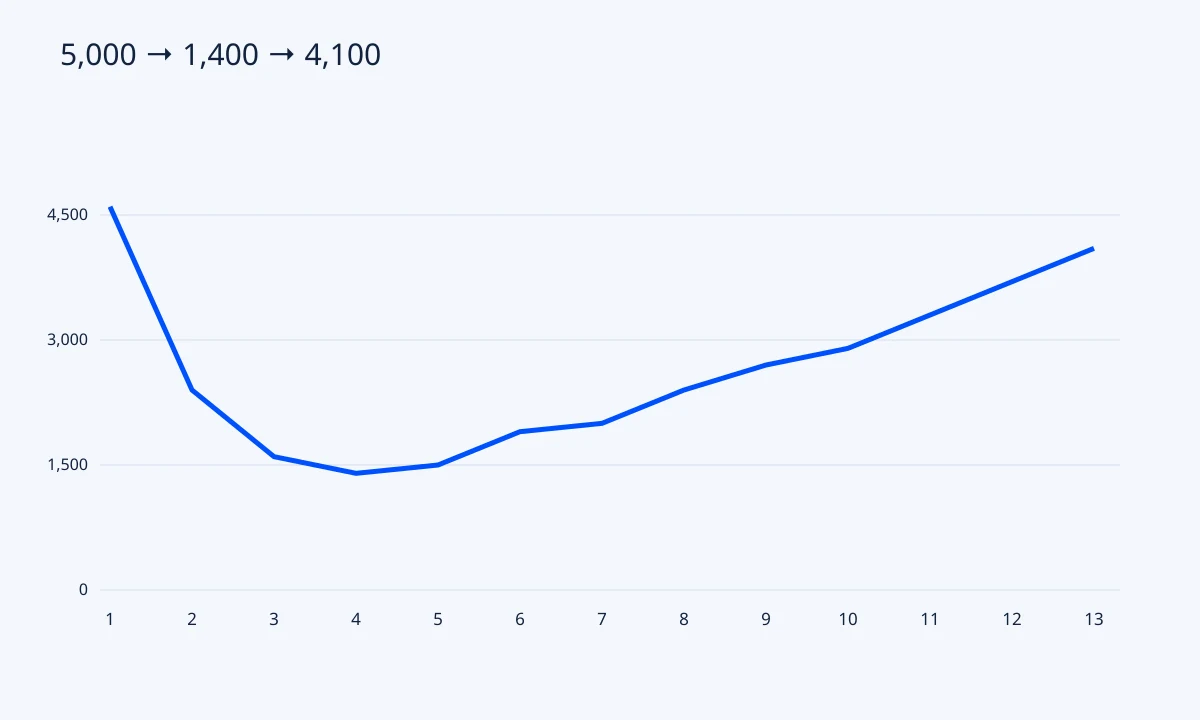
The calculation is opening cash + receipts − payments = closing cash. The closing figure becomes the next week's opening. In the example, opening cash is 5,000. Week 1 receives 3,600 and pays 4,000, closing at 4,600. Week 2 receives 3,800 and pays 6,000, closing at 2,400.
The full table reaches a low of 1,400 in week 4 and ends week 13 at 4,100. Against a chosen planning reserve of 1,500, week 4 already needs attention. The reserve is a management assumption, not an industry standard.
Now delay 2,500 of week 2 receipts until week 3. Week 2 closes at −100 instead of 2,400. When the receipt arrives in week 3, the closing balance returns to the baseline 1,600, assuming every other movement stays unchanged. The later recovery does not solve the earlier payment gap.
Use that warning to investigate realistic choices: confirm the settlement date, negotiate an agreed supplier schedule, defer an optional purchase or arrange authorised funding. Do not assume that payroll, tax or contractual bills can simply be moved. Record any approved financing and its repayment in the scenario.

Each week, replace the completed week with actual receipts and payments, reconcile the opening balance and add a new week 13. Explain material differences as timing or amount changes. Track whether an optimistic settlement assumption keeps reappearing instead of hiding the error in the next version.
Assign owners to large expected receipts and commitments. Separate confirmed, estimated and scenario amounts. A strong base case should still be tested against late payouts, slower sales and urgent replacement stock. Do not add a probability-weighted estimate to the full confirmed receipt for the same transaction.
StoreConsole Finance supports cash planning and payment workflows; Accounting keeps transaction and settlement evidence. Configure the available tools around your payment responsibilities. This thirteen-week example is a planning method, not a claim that the product includes this exact ready-made forecast layout. Review the weakest week before approving the next growth purchase.
About the Author
Anichur Rahaman
Continue Reading